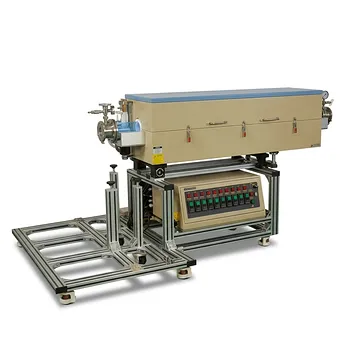
Why must a tube furnace equipped with an atmosphere control system be used during the phosphidation of nickel-based oxide intermediates? Guide
Updated 3 months ago
The use of a tube furnace with an atmosphere control system is indispensable for phosphidation because it isolates the reaction from ambient oxygen while providing a precise, high-temperature environment for gas-phase phosphorus diffusion. This setup prevents the nickel-based intermediates and substrates from oxidizing, ensures the complete conversion of oxides into phosphides, and allows for the fine-tuning of material properties like lattice defects and conductivity.
Core Takeaway: Atmosphere control is required to prevent unwanted oxidation and to manage the delicate solid-gas interface reaction between phosphorus vapor and metal oxides, ensuring the creation of high-purity nanocrystalline phosphides.
Prevention of Unwanted Oxidation
Protecting the Metal and Substrate
At the high temperatures required for phosphidation (often between 300°C and 600°C), nickel and other metallic components are highly susceptible to oxidation.
An atmosphere control system uses a sealed tube to introduce high-purity inert gases (like Argon or Nitrogen) or reducing gases (like H2). This environment effectively excludes oxygen and moisture, preventing the formation of undesirable oxide phases that would degrade the material's catalytic performance.
Maintaining Chemical Stoichiometry
Without a strictly controlled environment, the chemical stoichiometry of the final product would be inconsistent. The absence of oxygen ensures that the anion exchange reaction—where phosphorus replaces oxygen in the lattice—proceeds without competition from atmospheric oxygen.
Facilitating the Solid-Gas Interface Reaction
Controlled Decomposition of Phosphorus Sources
Phosphidation typically involves the thermal decomposition of a precursor, such as sodium hypophosphite, into phosphorus vapor or phosphine gas (PH3).
A tube furnace provides the precise programmed temperature control necessary to time this decomposition. This ensures that the phosphorus vapor is generated at the exact moment the metal oxide intermediates are ready for diffusion.
Uniform Gas Transport
The atmosphere control system acts as a delivery mechanism, using carrier gases to move phosphorus vapor across the sample surface.
This continuous flow ensures a uniform solid-gas interface reaction. This uniformity is critical for transforming crystalline oxides into nanocrystalline phosphides embedded within an amorphous matrix, avoiding localized over-reaction or under-reaction.
Engineering Advanced Material Properties
Introducing Lattice Defects and Vacancies
Precise control over the furnace atmosphere allows researchers to purposefully introduce lattice defects and oxygen vacancies.
By adjusting the ratio of reducing gases or the flow rate of the inert carrier, you can manipulate the surface electronic structure. This significantly enhances the electrical conductivity and catalytic activity of the nickel-based phosphides.
Enhancing Structural Adhesion
For catalysts grown on metallic substrates like nickel foam, atmosphere control prevents the substrate from undergoing oxidative degradation.
Protecting the substrate's structural integrity ensures strong bonding between the catalytic layer and the carrier. This results in better stability during long-term electrochemical applications.
Understanding the Trade-offs
Balancing Flow Rates and Pressure
While a high flow rate of carrier gas ensures the removal of reaction by-products, it can also dilute the phosphorus vapor too much. This dilution may lead to incomplete phosphidation, leaving oxide cores within the material.
Handling Hazardous By-products
The gas-phase phosphidation process generates phosphine (PH3), which is toxic and flammable.
A tube furnace system must be equipped with proper exhaust scrubbing or "bubbler" systems. Failure to manage the exit gases creates a significant safety hazard for the laboratory environment.
How to Apply This to Your Project
Selecting the Right Parameters for Your Goal
- If your primary focus is Phase Purity: Use a strictly inert Argon atmosphere and a slow temperature ramp to ensure full diffusion of phosphorus without oxide contamination.
- If your primary focus is High Conductivity: Introduce a controlled amount of Hydrogen (Ar/H2 mixture) to encourage the formation of oxygen vacancies and metallic phases.
- If your primary focus is Substrate Integrity: Keep phosphidation temperatures below 450°C and ensure the furnace is fully purged of oxygen before heating to prevent degradation of nickel foam or carbon cloths.
By mastering the atmosphere within a tube furnace, you transform a simple heat treatment into a precision engineering tool for high-performance nickel phosphide materials.
Summary Table:
| Key Feature | Role in Phosphidation Process |
|---|---|
| Oxidation Prevention | Uses inert gases (Ar/N2) to block oxygen, ensuring pure phosphide formation. |
| Gas Phase Control | Manages the decomposition of P-sources and uniform transport of phosphorus vapor. |
| Property Engineering | Facilitates the creation of lattice defects and oxygen vacancies for better activity. |
| Substrate Integrity | Protects nickel foam or carbon cloths from thermal degradation and oxidation. |
| Safety Management | Enables controlled exhaust scrubbing for hazardous by-products like Phosphine (PH3). |
Elevate Your Material Research with THERMUNITS Precision Furnaces
Achieving high-purity nanocrystalline phosphides requires absolute control over your thermal environment. THERMUNITS provides industry-leading thermal processing solutions designed specifically for advanced material science and industrial R&D.
Whether you need Tube Furnaces with integrated atmosphere controls, CVD/PECVD systems for precise gas-phase reactions, or high-performance Vacuum and Atmosphere Furnaces, our equipment ensures the chemical stoichiometry and structural integrity your catalysts demand.
Why partner with THERMUNITS?
- Precision Engineering: Accurate programmed temperature control and gas flow management.
- Versatile Solutions: From Rotary and Hot Press furnaces to Vacuum Induction Melting (VIM) systems.
- Expert Support: We help you select the right parameters for phase purity and high conductivity.
Ready to optimize your phosphidation process? Contact our technical team today to find the perfect thermal solution for your laboratory!
References
- Jiayao Fan, Min Han. Porous Flower‐Like Nanoarchitectures Derived from Nickel Phosphide Nanocrystals Anchored on Amorphous Vanadium Phosphate Nanosheet Nanohybrids for Superior Overall Water Splitting. DOI: 10.1002/smtd.202301279
Mentioned Products
- Vertical 1700C Vacuum and Atmosphere Tube Furnace with 80mm Alumina Tube
- 1750°C High Temperature Benchtop Vacuum Atmosphere Tube Furnace with Kanthal Super 1800 Heating Elements and 60mm Alumina Processing Tube
- 1200C Hybrid Muffle and Tube Furnace for Material Research with Dual Atmosphere Control Quartz Tubes
- Compact Hybrid Muffle and Tube Furnace for 1000C Controlled Atmosphere Laboratory Material Sintering
- Three Zone Tube Furnace with 11 Inch or 15 Inch Quartz Tube and Hinged Flanges for Vacuum Atmosphere Heat Treatment
People Also Ask
- How is an industrial-grade vertical tube furnace utilized in smelting leaching residues? Enhance Metal Recovery Efficiency
- What is the function of a laboratory-grade vertical tube furnace in fast pyrolysis? Optimize Composite Research.
- How does a vertical tube furnace facilitate thermoelectric alloy melting? Precision synthesis for material homogeneity.
- Why is a thermocouple sensor indispensable for monitoring the vertical tube furnace during gallium oxide nanowire production? Optimize VLS Growth
- What are the advantages of using a vertical tube furnace for crucible experiments simulating steel-slag interactions?

Tech Team · ThermUnits
Last updated on Jun 03, 2026
Related Products

Vertical 1700C Vacuum and Atmosphere Tube Furnace with 80mm Alumina Tube

1750°C High Temperature Benchtop Vacuum Atmosphere Tube Furnace with Kanthal Super 1800 Heating Elements and 60mm Alumina Processing Tube
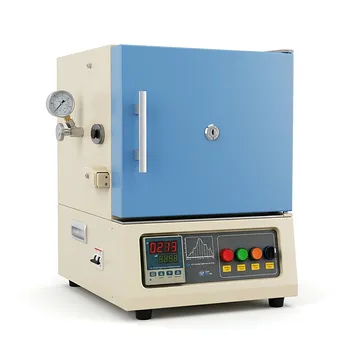
1200C Hybrid Muffle and Tube Furnace for Material Research with Dual Atmosphere Control Quartz Tubes
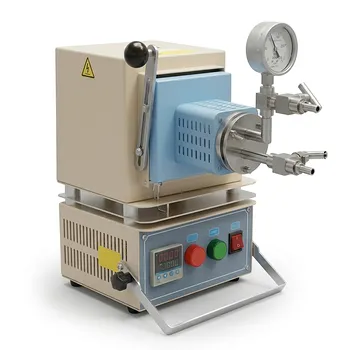
Compact Hybrid Muffle and Tube Furnace for 1000C Controlled Atmosphere Laboratory Material Sintering

Three Zone Tube Furnace with 11 Inch or 15 Inch Quartz Tube and Hinged Flanges for Vacuum Atmosphere Heat Treatment
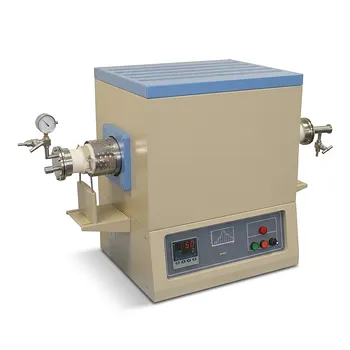
1700C High Temperature Alumina Tube Furnace with 18 Inch Heated Zone and Vacuum Sealing Flanges
1100°C High Temperature Quartz Chamber Furnace 8 Inch OD with 7.6 Liter Capacity and Vacuum Atmosphere Capability
High Temperature Hydrogen Atmosphere Box Furnace 1650C Max Reducing Environment Material Synthesis System 8x8x8 Chamber

1200°C 5 Inch Vertical Quartz Tube Furnace with Stainless Steel Vacuum Flanges
High Temperature 1600C Split Tube Furnace Vacuum Flanges Valves Optional 60mm 80mm Alumina Tube

High Temperature 1700C Tube Furnace with High Vacuum Turbomolecular Pump System and Multi Channel Mass Flow Controller Gas Mixer

1100C Tube Furnace with Vacuum Flange and Programmable Temperature Controller for Material Science and Industrial Heat Treatment

High Temperature 1700C Vertical Tube Furnace for Powder Spherification and Material Sintering

Compact High Temperature 1600C Tube Furnace with 50mm Alumina Tube and Vacuum Flanges for Material Sintering

High Temperature 1700C Six Zone Split Tube Furnace with Alumina Tube and Water Cooled Flanges

1800C High Temperature Compact Vacuum Tube Furnace with 60mm OD Alumina Tube and Kanthal MoSi2 Heating Elements

1700C Hydrogen Gas Tube Furnace with 60mm Alumina Process Tube and Integrated Hydrogen Safety Detector

High Temperature 1700C Benchtop Tube Furnace with 5 Inch Heating Zone High Purity Alumina Tube and Vacuum Sealing Flanges

High Temperature Automated 5 Inch Tube Furnace for Autonomous Material Research and Advanced Laboratory R&D