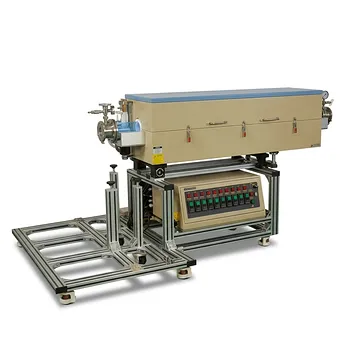
How does a high-temperature tube furnace facilitate the conversion of TiO2@Fe2O3 into TiO2@Fe3O4@C? Precision Synthesis
Updated 3 months ago
The high-temperature tube furnace acts as a thermal reactor that simultaneously carbonizes organic precursors and reduces metal oxides through precise atmosphere control. Specifically, it provides a stable 600 °C isothermal environment and an inert argon atmosphere that triggers the pyrolysis of Polyvinylpyrrolidone (PVP) into amorphous carbon. This carbon then acts as a reducing agent, converting the outer $\text{Fe}_2\text{O}_3$ layer into electrochemically active $\text{Fe}_3\text{O}_4$ while forming a protective carbon shell.
Core Takeaway: The furnace facilitates a multi-step "in-situ" transformation where thermal energy and an inert atmosphere allow a carbon source to simultaneously reduce iron oxide and form a conductive outer coating, resulting in a stable $\text{TiO}_2\text{@Fe}_3\text{O}_4\text{@C}$ structure.
The Role of Atmosphere Control in Chemical Synthesis
Maintaining an Inert Argon Environment
The tube furnace provides a sealed environment that replaces ambient air with argon gas. This inert atmosphere is critical because it prevents the carbon and iron components from reacting with oxygen at high temperatures.
Facilitating Carbon-Driven Reduction
By isolating the sample from oxygen, the furnace allows the carbon reduction reaction to occur internally. Without this precise atmosphere, the PVP would simply burn away rather than reducing the $\text{Fe}_2\text{O}_3$ to $\text{Fe}_3\text{O}_4$.
Thermal Triggering of Phase Transformations
Pyrolysis of the PVP Precursor
The 600 °C isothermal environment provides the specific activation energy required to decompose PVP (Polyvinylpyrrolidone). This process, known as pyrolysis, transforms the polymer into a uniform layer of amorphous carbon.
In-Situ Reduction of Iron Oxide
As the PVP decomposes into carbon, it reacts with the surrounding $\text{Fe}_2\text{O}_3$ layer. The heat drives a chemical reduction that strips oxygen from the hematite ($\text{Fe}_2\text{O}_3$), converting it into the more electrochemically active magnetite ($\text{Fe}_3\text{O}_4$).
Structural Integrity and Morphological Control
Formation of the Core-Double Shell
The furnace ensures that these reactions happen sequentially and uniformly across the material. This result is a sophisticated core-double shell structure where the $\text{TiO}_2$ core is protected by an inner magnetic layer and an outer conductive carbon layer.
Precision Temperature Management
Maintaining a constant 600 °C is vital for phase purity. Deviating from this temperature could result in incomplete reduction of the iron oxide or the unwanted formation of different crystalline phases of titanium dioxide.
Understanding the Trade-offs
Temperature Sensitivity
If the furnace temperature is too low, the PVP may not fully carbonize, leading to poor conductivity. Conversely, excessively high temperatures can cause grain growth and sintering, which reduces the surface area and degrades the electrochemical performance of the material.
Atmosphere Purity and Flow Rate
The success of the synthesis depends heavily on the purity of the argon and the stability of the flow rate. Any trace oxygen leakage into the tube can halt the reduction process or lead to the oxidation of the newly formed carbon shell.
Applying Furnace Parameters to Your Synthesis
How to Apply This to Your Project
- If your primary focus is maximizing conductivity: Ensure a slow heating rate to allow the PVP to form a dense, uniform amorphous carbon layer without creating structural voids.
- If your primary focus is magnetic phase purity: Maintain a strict isothermal hold at 600 °C to ensure the complete conversion of $\text{Fe}_2\text{O}_3$ to $\text{Fe}_3\text{O}_4$ without over-reducing the metal.
- If your primary focus is structural stability: Use a controlled cooling program after the 600 °C soak to eliminate internal stresses and prevent the shell from delaminating from the $\text{TiO}_2$ core.
By masterfully balancing temperature and atmosphere, the tube furnace transforms simple precursors into complex, high-performance heterostructures.
Summary Table:
| Furnace Parameter | Synthesis Function | Structural Outcome |
|---|---|---|
| Inert Atmosphere | Maintains Argon environment | Prevents unwanted oxidation; enables carbon reduction |
| Isothermal 600°C | Provides stable activation energy | Triggers PVP pyrolysis into amorphous carbon shell |
| Thermal Reduction | Facilitates in-situ chemical reaction | Converts Fe2O3 to Fe3O4 for magnetic activity |
| Precision Control | Manages heating/cooling rates | Ensures phase purity and prevents shell delamination |
Achieve Precision in Your Material Synthesis with THERMUNITS
Are you looking to master complex core-shell structures like TiO2@Fe3O4@C? THERMUNITS is a leading manufacturer of high-temperature laboratory equipment, providing the exact thermal environments needed for advanced material science and industrial R&D.
Our comprehensive range of thermal processing solutions includes:
- Precision Tube & Atmosphere Furnaces (Ideal for CVD/PECVD and reduction processes)
- Vacuum, Muffle, and Rotary Kilns
- Hot Press & Vacuum Induction Melting (VIM) Furnaces
- Dental Furnaces & High-Quality Thermal Elements
Don't let temperature fluctuations or atmosphere leaks compromise your research. Contact our technical team today to discuss how our high-performance furnace solutions can enhance your laboratory's efficiency and ensure superior material performance.
References
- Yuan Chen, Jan-Michael Albina. Core–Double-Shell TiO2@Fe3O4@C Microspheres with Enhanced Cycling Performance as Anode Materials for Lithium-Ion Batteries. DOI: 10.3390/ma17112543
Mentioned Products
- High Temperature Tube Furnace 1500C with Sliding Flanges and 50mm OD for Rapid Thermal Processing Fast Heating and Cooling
- High Temperature 1700C Tube Furnace with High Vacuum Turbomolecular Pump System and Multi Channel Mass Flow Controller Gas Mixer
- High Temperature 1700C Benchtop Tube Furnace with 5 Inch Heating Zone High Purity Alumina Tube and Vacuum Sealing Flanges
- 1700C High Temperature Alumina Tube Furnace with 18 Inch Heated Zone and Vacuum Sealing Flanges
- 1750°C High Temperature Benchtop Vacuum Atmosphere Tube Furnace with Kanthal Super 1800 Heating Elements and 60mm Alumina Processing Tube
People Also Ask
- How are high-temperature tube furnaces utilized to repair etching damage? Precision Lattice Restoration Solutions
- What core conditions does a high-temperature tube furnace provide for rGO aerogels? Mastering Precision Synthesis.
- What role does a high-temperature tube furnace play in CVD synthesis of silicon nanowires? Master VLS Growth Precision.
- How does precision tube furnace control influence CoFe nanoparticle formation? Master Your Bimetallic Synthesis.
- What role does a high-temperature tube furnace play in the sulfidation heat treatment of CoS@C/MXene nanocomposites? Guide

Tech Team · ThermUnits
Last updated on Jun 03, 2026
Related Products
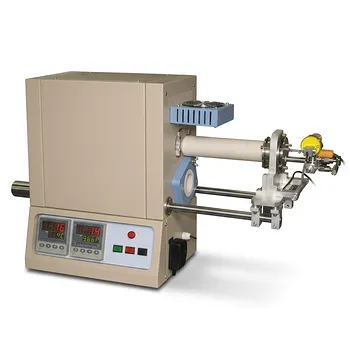
High Temperature Tube Furnace 1500C with Sliding Flanges and 50mm OD for Rapid Thermal Processing Fast Heating and Cooling

High Temperature 1700C Tube Furnace with High Vacuum Turbomolecular Pump System and Multi Channel Mass Flow Controller Gas Mixer

High Temperature 1700C Benchtop Tube Furnace with 5 Inch Heating Zone High Purity Alumina Tube and Vacuum Sealing Flanges
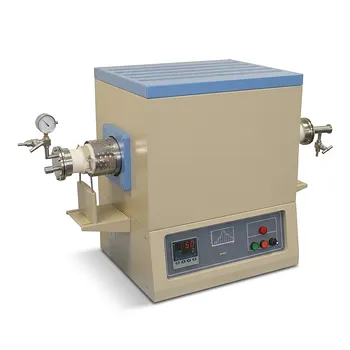
1700C High Temperature Alumina Tube Furnace with 18 Inch Heated Zone and Vacuum Sealing Flanges

1750°C High Temperature Benchtop Vacuum Atmosphere Tube Furnace with Kanthal Super 1800 Heating Elements and 60mm Alumina Processing Tube

Compact High Temperature 1600C Tube Furnace with 50mm Alumina Tube and Vacuum Flanges for Material Sintering

1800C High Temperature Compact Vacuum Tube Furnace with 60mm OD Alumina Tube and Kanthal MoSi2 Heating Elements
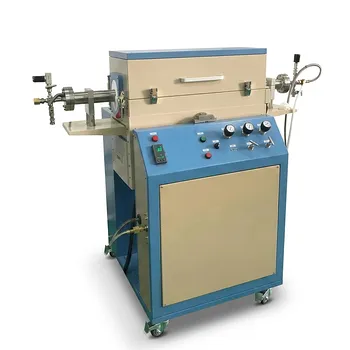
High Temperature Rocking Tube Furnace 1700°C Alumina Processing Tube with Precision Oscillation for Material Synthesis
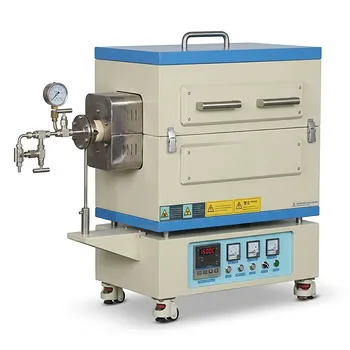
High Temperature Split Tube Furnace 1500C for Material Research Vacuum and Atmosphere Thermal Processing
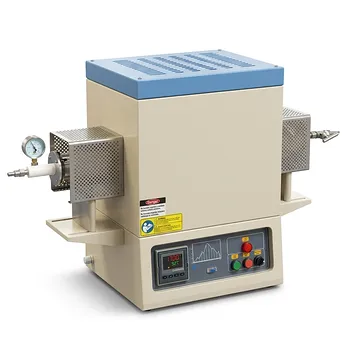
High Temperature Three Zone Tube Furnace 1700C with Alumina Tube and Water Cooled Flanges

High Temperature 1700C Vertical Tube Furnace for Powder Spherification and Material Sintering
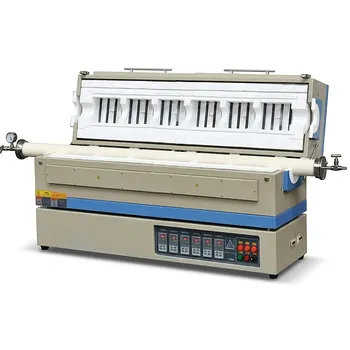
High Temperature 1700C Six Zone Split Tube Furnace with Alumina Tube and Water Cooled Flanges
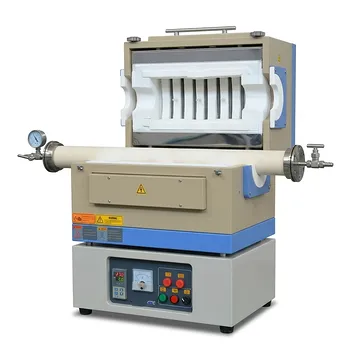
High Temperature 1600C Split Tube Furnace Vacuum Flanges Valves Optional 60mm 80mm Alumina Tube

High Temperature Automated 5 Inch Tube Furnace for Autonomous Material Research and Advanced Laboratory R&D
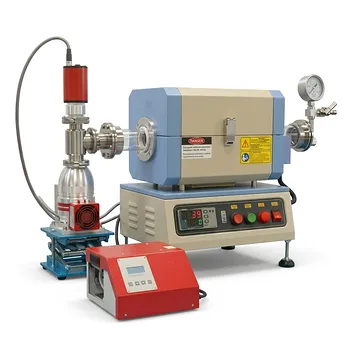
High Vacuum Compact Tube Furnace 1200C with Integrated Turbo Pump System and 8 Inch Heating Zone
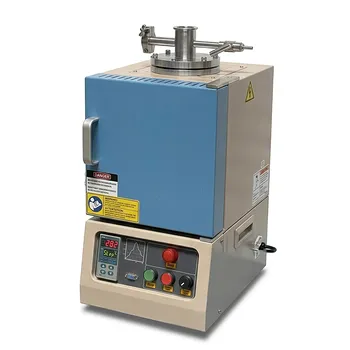
High Temperature Hybrid Muffle and Tube Furnace with Vacuum Capability and PID Control
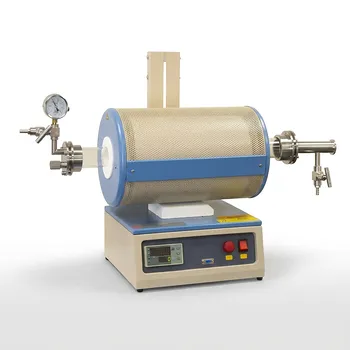
1100C Tube Furnace with Vacuum Flange and Programmable Temperature Controller for Material Science and Industrial Heat Treatment

1100°C High Temperature Quartz Chamber Furnace 8 Inch OD with 7.6 Liter Capacity and Vacuum Atmosphere Capability
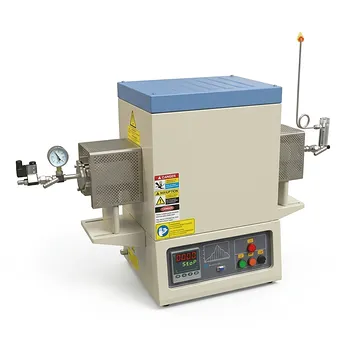
1700C Hydrogen Gas Tube Furnace with 60mm Alumina Process Tube and Integrated Hydrogen Safety Detector