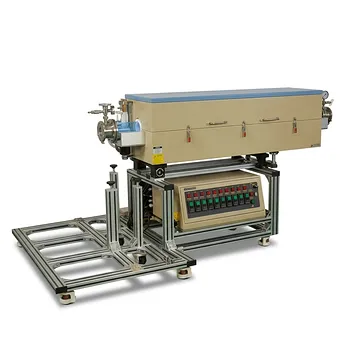
What are the primary functions of a high-temperature tube furnace in the online regulation of Au-Sn nanoparticles?
Updated 3 months ago
The high-temperature tube furnace serves as the definitive tool for in-flight annealing in the online regulation of Au-Sn nanoparticles. Positioned immediately after the generation equipment, it provides a controlled thermal environment—typically between 300 °C and 1100 °C—to facilitate the sintering of loose grain aggregates. This process is essential for achieving precise control over the morphology, crystal structure, and phase composition of the particles as they move through the system.
Core Takeaway: A high-temperature tube furnace acts as a real-time thermal reactor that transforms loose, as-generated aggregates into dense, phase-pure nanoparticles by enabling in-flight sintering and structural refinement under precise temperature and atmospheric conditions.
Facilitating In-Flight Annealing and Sintering
Consolidation of Loose Aggregates
During the initial generation phase, Au-Sn particles often emerge as loose grain aggregates rather than solid spheres. The tube furnace provides the thermal energy necessary to initiate sintering, which merges these clusters into consolidated nanoparticles.
Morphology Regulation
By applying specific heat profiles, the furnace allows researchers to reshape the particles "in-flight." This ensures that the final morphology—the physical shape and surface structure—meets the required technical specifications before the particles reach the collection or deposition stage.
Particle Densification
As the particles pass through the heated zone, the thermal energy drives out internal voids and gaps. This densification is critical for ensuring that the nanoparticles possess the mechanical and chemical stability needed for their intended application.
Regulating Crystal Structure and Phase Composition
Precision Phase Transformation
The specific alloy phase of Au-Sn (such as the ratio of gold to tin) is highly sensitive to temperature. The tube furnace provides a stable thermal field that allows the atomic lattice to rearrange into the desired crystalline phase.
Achieving High Crystallinity
A high-temperature environment promotes deep chemical reactions and crystal growth. This process minimizes defects within the nanoparticle lattice, resulting in high-purity, high-crystallinity materials with specific orientations.
Preventing Dealloying and Phase Separation
Consistent temperature control ensures that the alloy components remain integrated. Without this stable environment, the nanoparticles might undergo dealloying, where the tin and gold separate, compromising the functionality of the material.
Maintaining Atmospheric Integrity
Prevention of Oxidation
High-temperature processing of metallic nanoparticles like Au-Sn requires a sealed reaction space. The tube furnace maintains a protective or reducing atmosphere (often using nitrogen or argon) to prevent oxygen from reacting with the tin or gold.
Simulating Service Environments
In advanced applications, the furnace can be used to simulate the actual environments these materials will face, such as the high-heat zones of power generation units. This allows for the evaluation of long-term service performance and thermal stability.
Chemical Vapor Interaction
If the process involves precursors, the furnace provides the platform for Chemical Vapor Deposition (CVD). It ensures that any necessary chemical transformations occur under exact physical conditions before the particles exit the stream.
Understanding the Trade-offs
Temperature vs. Residence Time
The primary challenge in online regulation is the limited time a particle spends inside the furnace (residence time). If the temperature is too low or the flow rate too high, the particles may not fully sinter, leaving them as loose aggregates.
Risk of Grain Overgrowth
While high temperatures facilitate sintering, excessive heat can lead to unwanted grain growth or particle agglomeration. If the temperature exceeds the ideal range for the specific Au-Sn ratio, the particles may fuse into larger masses, losing their "nano" characteristics.
Atmospheric Contamination
Despite being a sealed system, any breach in the furnace seals or impurities in the gas lines can lead to immediate oxidation. This is particularly critical at the high temperatures (up to 1100 °C) required for Au-Sn, where chemical reactivity is significantly heightened.
How to Apply This to Your Project
Making the Right Choice for Your Goal
- If your primary focus is Morphology Control: Prioritize a multi-zone furnace to create a temperature gradient that allows for gradual sintering and densification.
- If your primary focus is Phase Purity: Select a furnace with high-precision PID controllers to maintain a constant, stable temperature that matches the specific Au-Sn phase diagram.
- If your primary focus is Oxidation Prevention: Ensure the furnace system is equipped with advanced gas purification and high-integrity vacuum seals for an oxygen-free processing environment.
The high-temperature tube furnace is the indispensable "thermal engine" that enables the transformation of raw aerosols into sophisticated, engineered Au-Sn nanoparticles.
Summary Table:
| Function | Process Detail | Impact on Nanoparticles |
|---|---|---|
| Sintering | Consolidation of loose aggregates | Densification & mechanical stability |
| Morphology | Controlled thermal profiling | Precise physical shape & surface structure |
| Phase Control | Atomic lattice rearrangement | High crystallinity & specific phase purity |
| Atmosphere | Inert/Reducing gas environment | Prevention of oxidation & dealloying |
Optimize Your Nanoparticle Synthesis with THERMUNITS
As a leading manufacturer of high-temperature laboratory equipment for material science, THERMUNITS provides the precision thermal solutions required for advanced industrial R&D. Our high-performance Tube Furnaces and CVD/PECVD systems are engineered to deliver the stable thermal fields and atmospheric integrity necessary for perfect Au-Sn nanoparticle regulation.
Why Partner with THERMUNITS?
- Comprehensive Range: We offer Muffle, Vacuum, Atmosphere, Rotary, and Hot Press furnaces, plus Vacuum Induction Melting (VIM) and dental solutions.
- Precision Engineering: Achieve high-purity crystalline phases with advanced PID temperature control.
- Expert Support: We tailor our thermal elements and heat treatment equipment to your specific research goals.
Ready to elevate your lab's efficiency and material quality? Contact us today to discuss your project!
References
- Pau Ternero, Maria E. Messing. In-Flight Tuning of Au–Sn Nanoparticle Properties. DOI: 10.1021/acs.langmuir.4c01656
Mentioned Products
- High Temperature Tube Furnace 1500C with Sliding Flanges and 50mm OD for Rapid Thermal Processing Fast Heating and Cooling
- High Temperature 1700C Tube Furnace with High Vacuum Turbomolecular Pump System and Multi Channel Mass Flow Controller Gas Mixer
- High Temperature 1700C Benchtop Tube Furnace with 5 Inch Heating Zone High Purity Alumina Tube and Vacuum Sealing Flanges
- 1750°C High Temperature Benchtop Vacuum Atmosphere Tube Furnace with Kanthal Super 1800 Heating Elements and 60mm Alumina Processing Tube
- Compact High Temperature 1600C Tube Furnace with 50mm Alumina Tube and Vacuum Flanges for Material Sintering
People Also Ask
- How are high-temperature tube furnaces utilized to repair etching damage? Precision Lattice Restoration Solutions
- What role does a high-temperature tube furnace play in CVD synthesis of silicon nanowires? Master VLS Growth Precision.
- What core conditions does a high-temperature tube furnace provide for rGO aerogels? Mastering Precision Synthesis.
- What role does a high-temperature tube furnace play in the sulfidation heat treatment of CoS@C/MXene nanocomposites? Guide
- How does precision tube furnace control influence CoFe nanoparticle formation? Master Your Bimetallic Synthesis.

Tech Team · ThermUnits
Last updated on Jun 03, 2026
Related Products

High Temperature Tube Furnace 1500C with Sliding Flanges and 50mm OD for Rapid Thermal Processing Fast Heating and Cooling

High Temperature 1700C Tube Furnace with High Vacuum Turbomolecular Pump System and Multi Channel Mass Flow Controller Gas Mixer

High Temperature 1700C Benchtop Tube Furnace with 5 Inch Heating Zone High Purity Alumina Tube and Vacuum Sealing Flanges

1750°C High Temperature Benchtop Vacuum Atmosphere Tube Furnace with Kanthal Super 1800 Heating Elements and 60mm Alumina Processing Tube

Compact High Temperature 1600C Tube Furnace with 50mm Alumina Tube and Vacuum Flanges for Material Sintering
1700C High Temperature Alumina Tube Furnace with 18 Inch Heated Zone and Vacuum Sealing Flanges

1800C High Temperature Compact Vacuum Tube Furnace with 60mm OD Alumina Tube and Kanthal MoSi2 Heating Elements
High Temperature Split Tube Furnace 1500C for Material Research Vacuum and Atmosphere Thermal Processing

High Temperature 1700C Vertical Tube Furnace for Powder Spherification and Material Sintering
High Temperature Three Zone Tube Furnace 1700C with Alumina Tube and Water Cooled Flanges

High Temperature 1700C Six Zone Split Tube Furnace with Alumina Tube and Water Cooled Flanges
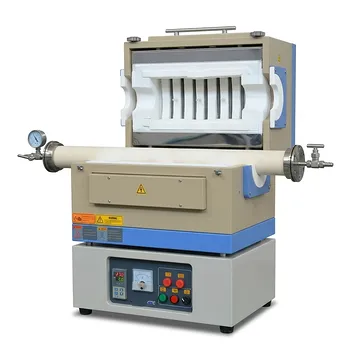
High Temperature 1600C Split Tube Furnace Vacuum Flanges Valves Optional 60mm 80mm Alumina Tube

High Temperature Automated 5 Inch Tube Furnace for Autonomous Material Research and Advanced Laboratory R&D

1100C Tube Furnace with Vacuum Flange and Programmable Temperature Controller for Material Science and Industrial Heat Treatment
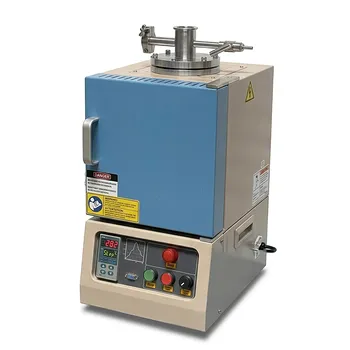
High Temperature Hybrid Muffle and Tube Furnace with Vacuum Capability and PID Control
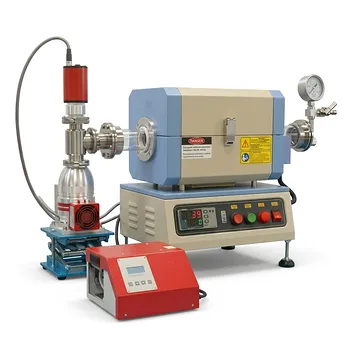
High Vacuum Compact Tube Furnace 1200C with Integrated Turbo Pump System and 8 Inch Heating Zone

1700C Hydrogen Gas Tube Furnace with 60mm Alumina Process Tube and Integrated Hydrogen Safety Detector
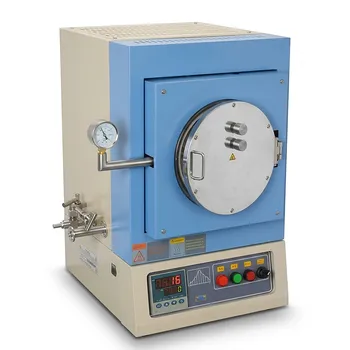
1100°C High Temperature Quartz Chamber Furnace 8 Inch OD with 7.6 Liter Capacity and Vacuum Atmosphere Capability
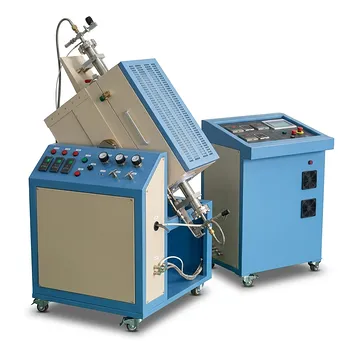
1100C High Pressure Rocking Tube Furnace with 2 Inch Super Alloy Processing Tube for Material Synthesis