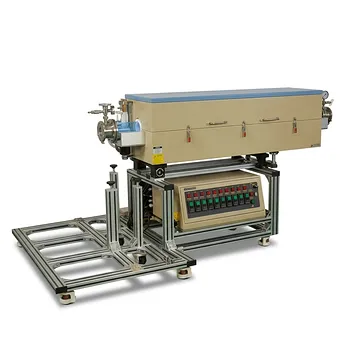
What is the function of a high-temperature tube furnace in the solid-state synthesis of NASICON-type LiZr2(PO4)3?
Updated 3 months ago
The high-temperature tube furnace is the critical thermal reactor used to transform raw chemical precursors into a high-purity crystalline electrolyte. It facilitates a multi-stage heating process that first decomposes volatile components and then drives the solid-state reaction necessary to form the specific NASICON-type crystal structure. Without the precise thermal field provided by this furnace, the resulting material would lack the purity and ionic conductivity required for solid-state battery applications.
Core Takeaway: The tube furnace provides a controlled, staged environment that manages precursor decomposition, the removal of gaseous byproducts, and the high-energy atomic diffusion needed to synthesize phase-pure $LiZr_2(PO_4)_3$.
The Role of Multi-Stage Thermal Control
Facilitating Precursor Decomposition
During the initial heating stages at 500 °C and 800 °C, the tube furnace enables the breakdown of raw materials. This process is essential for the evaporation of carbon dioxide, ammonia, and water vapor, ensuring that these byproducts do not remain as impurities in the final electrolyte.
Driving High-Temperature Solid-State Reactions
A prolonged holding period at 1200 °C provides the thermal energy required for atomic diffusion. At this temperature, the furnace maintains a stable thermal field that allows the remaining solids to react chemically, forming the desired $LiZr_2(PO_4)_3$ ceramic powder.
Achieving High-Purity Initial Powders
The precision of the furnace's programmed temperature control ensures that the reaction reaches completion. By maintaining a consistent temperature profile, the furnace prevents the formation of secondary phases, resulting in a high-purity initial powder with the correct stoichiometry.
Optimizing the NASICON Crystal Structure
Promoting Crystal Growth and Symmetry
The furnace environment induces the formation of the NASICON structure, which is characterized by high crystallinity and specific space group symmetry. This structure is vital because it creates the "tunnels" through which lithium ions move, directly influencing the ion transport characteristics of the electrolyte.
Atmosphere and Contamination Control
Tube furnaces provide a strictly sealed environment that can be used to manage the atmosphere during synthesis. Similar to the processing of LLZO or $LiNiO_2$, this isolation prevents the material from reacting with moisture or $CO_2$ in the air, which would otherwise form lithium carbonate impurities that degrade performance.
Controlling Reaction Kinetics
The ability to set precise heating and cooling rates (e.g., 2°C/min) is essential for managing the physical integrity of the powder. Controlled cooling prevents the buildup of internal thermal stress and allows for the management of the final grain size of the electrolyte particles.
Understanding the Trade-offs
Thermal Gradients and Uniformity
While tube furnaces offer excellent atmosphere control, they can sometimes suffer from radial temperature gradients. If the precursor material is not distributed evenly or if the tube is too large, the center of the sample may not reach the target 1200 °C simultaneously with the edges, leading to inconsistent crystallization.
Volatilization of Lithium
At the high temperatures required for $LiZr_2(PO_4)_3$ synthesis (specifically the 1200 °C stage), lithium loss due to volatilization becomes a risk. Researchers must often balance the need for high-temperature reaction energy against the potential for creating lithium vacancies, which can negatively impact the ionic conductivity of the final product.
How to Apply This to Your Project
Implementation Guidelines
Depending on your specific research or production goals, your approach to using the tube furnace will vary.
- If your primary focus is Phase Purity: Ensure the furnace is programmed with long dwell times at the 500 °C and 800 °C stages to guarantee the complete removal of $NH_3$ and $CO_2$ before the final sintering.
- If your primary focus is High Ionic Conductivity: Utilize a strictly controlled argon or oxygen flow within the tube to prevent the formation of resistive grain-boundary impurities like lithium carbonate.
- If your primary focus is Structural Integrity: Implement a slow cooling ramp (1–2 °C/min) to prevent micro-cracking within the NASICON crystal lattice caused by rapid thermal contraction.
By masterfully controlling the thermal environment of the tube furnace, you ensure the synthesis of a robust and efficient $LiZr_2(PO_4)_3$ electrolyte.
Summary Table:
| Synthesis Stage | Temperature Range | Primary Function/Result |
|---|---|---|
| Precursor Decomposition | 500°C - 800°C | Removes volatile byproducts (CO2, NH3, H2O) to ensure purity. |
| Solid-State Reaction | ~1200°C | Drives atomic diffusion to form the NASICON crystal structure. |
| Atmosphere Control | Steady Flow/Sealed | Prevents lithium carbonate formation and moisture contamination. |
| Reaction Kinetics | Controlled Ramp (1-2°C/min) | Manages grain size and prevents internal thermal stress/cracking. |
Optimize Your Battery Material Synthesis with THERMUNITS
Achieving phase-pure NASICON electrolytes requires the uncompromising thermal precision that only expert-engineered equipment can provide. THERMUNITS is a leading manufacturer of high-temperature laboratory equipment dedicated to advancing material science and industrial R&D.
We offer a comprehensive range of thermal processing solutions tailored for high-performance research, including:
- Tube & Rotary Furnaces for uniform powder synthesis.
- Muffle, Vacuum, and Atmosphere Furnaces for precise environment control.
- CVD/PECVD Systems & Hot Press Furnaces for advanced thin-film and dense ceramic applications.
- Specialized Equipment: Dental Furnaces, Electric Rotary Kilns, and Vacuum Induction Melting (VIM) furnaces.
Let THERMUNITS help you achieve superior ionic conductivity and material stability in your solid-state battery projects.
Contact Our Technical Experts Today to discuss your specific heating requirements and discover how our thermal elements and systems can enhance your laboratory's efficiency.
References
- Lin Lin, Kelsey B. Hatzell. Polymorphism control of fast-sintered NASICON-type LiZr<sub>2</sub>(PO<sub>4</sub>)<sub>3</sub>. DOI: 10.1039/d4ta04507f
Mentioned Products
- High Temperature Tube Furnace 1500C with Sliding Flanges and 50mm OD for Rapid Thermal Processing Fast Heating and Cooling
- High Temperature 1700C Tube Furnace with High Vacuum Turbomolecular Pump System and Multi Channel Mass Flow Controller Gas Mixer
- High Temperature 1700C Benchtop Tube Furnace with 5 Inch Heating Zone High Purity Alumina Tube and Vacuum Sealing Flanges
- 1750°C High Temperature Benchtop Vacuum Atmosphere Tube Furnace with Kanthal Super 1800 Heating Elements and 60mm Alumina Processing Tube
- Compact High Temperature 1600C Tube Furnace with 50mm Alumina Tube and Vacuum Flanges for Material Sintering
People Also Ask
- How are high-temperature tube furnaces utilized to repair etching damage? Precision Lattice Restoration Solutions
- What role does a high-temperature tube furnace play in CVD synthesis of silicon nanowires? Master VLS Growth Precision.
- What core conditions does a high-temperature tube furnace provide for rGO aerogels? Mastering Precision Synthesis.
- What role does a high-temperature tube furnace play in the sulfidation heat treatment of CoS@C/MXene nanocomposites? Guide
- How does precision tube furnace control influence CoFe nanoparticle formation? Master Your Bimetallic Synthesis.

Tech Team · ThermUnits
Last updated on Jun 02, 2026
Related Products
High Temperature Tube Furnace 1500C with Sliding Flanges and 50mm OD for Rapid Thermal Processing Fast Heating and Cooling

High Temperature 1700C Tube Furnace with High Vacuum Turbomolecular Pump System and Multi Channel Mass Flow Controller Gas Mixer

High Temperature 1700C Benchtop Tube Furnace with 5 Inch Heating Zone High Purity Alumina Tube and Vacuum Sealing Flanges
1750°C High Temperature Benchtop Vacuum Atmosphere Tube Furnace with Kanthal Super 1800 Heating Elements and 60mm Alumina Processing Tube

Compact High Temperature 1600C Tube Furnace with 50mm Alumina Tube and Vacuum Flanges for Material Sintering
1700C High Temperature Alumina Tube Furnace with 18 Inch Heated Zone and Vacuum Sealing Flanges

1800C High Temperature Compact Vacuum Tube Furnace with 60mm OD Alumina Tube and Kanthal MoSi2 Heating Elements
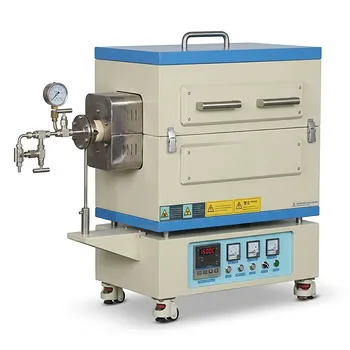
High Temperature Split Tube Furnace 1500C for Material Research Vacuum and Atmosphere Thermal Processing

High Temperature 1700C Vertical Tube Furnace for Powder Spherification and Material Sintering
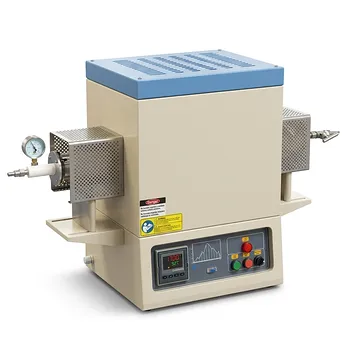
High Temperature Three Zone Tube Furnace 1700C with Alumina Tube and Water Cooled Flanges

High Temperature 1700C Six Zone Split Tube Furnace with Alumina Tube and Water Cooled Flanges
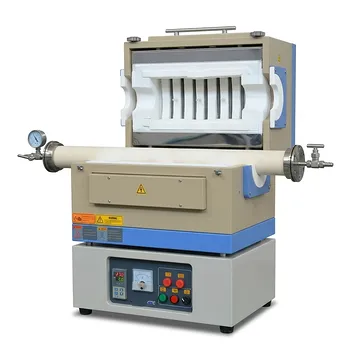
High Temperature 1600C Split Tube Furnace Vacuum Flanges Valves Optional 60mm 80mm Alumina Tube

High Temperature Automated 5 Inch Tube Furnace for Autonomous Material Research and Advanced Laboratory R&D

1100C Tube Furnace with Vacuum Flange and Programmable Temperature Controller for Material Science and Industrial Heat Treatment
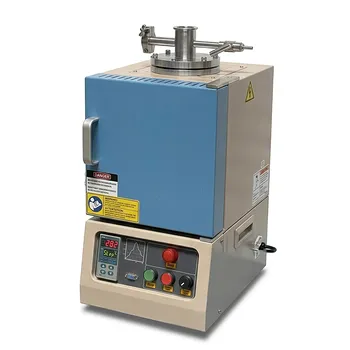
High Temperature Hybrid Muffle and Tube Furnace with Vacuum Capability and PID Control
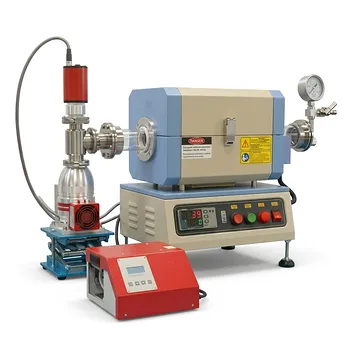
High Vacuum Compact Tube Furnace 1200C with Integrated Turbo Pump System and 8 Inch Heating Zone
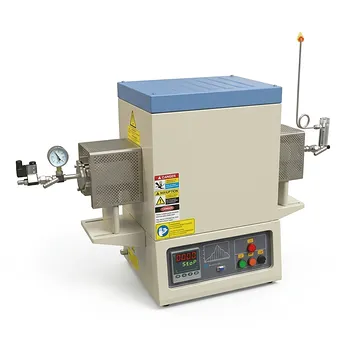
1700C Hydrogen Gas Tube Furnace with 60mm Alumina Process Tube and Integrated Hydrogen Safety Detector
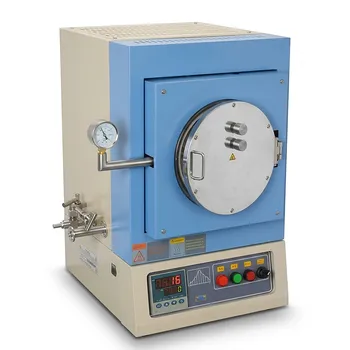
1100°C High Temperature Quartz Chamber Furnace 8 Inch OD with 7.6 Liter Capacity and Vacuum Atmosphere Capability
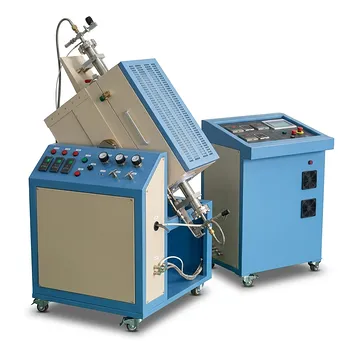
1100C High Pressure Rocking Tube Furnace with 2 Inch Super Alloy Processing Tube for Material Synthesis