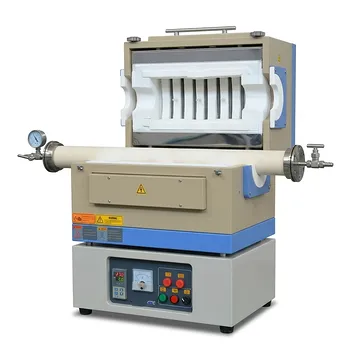
What role does a high-temperature tube atmosphere furnace play in the carbonization of 3D-printed precursors? Expert Guide
Updated 3 months ago
A high-temperature tube atmosphere furnace serves as the critical reactor for transforming 3D-printed polymers into functional pyrolytic carbon structures. It provides a strictly controlled, oxygen-free environment and precise thermal management required to decompose organic precursors into stable carbon electrodes. This process ensures the material gains high electrical conductivity while preserving the intricate microscopic morphology of the original 3D-printed design.
The furnace acts as an isolation chamber that enables anaerobic pyrolysis, allowing polymer molecules to rearrange into carbon skeletons without oxidative damage. Its primary value lies in its ability to synchronize chemical transformation with structural preservation through uniform temperature distribution.
Facilitating Molecular Transformation
Breaking and Rearranging Polymer Chains
The furnace facilitates the thermal decomposition of polymer molecules within the 3D-printed precursor. By precisely managing heating rates, it allows for the breaking and rearrangement of these molecules into a stable carbon framework.
Achieving High Electrical Conductivity
Through high-temperature processing—often reaching 1000 °C or higher—the furnace promotes the elimination of non-carbon elements. This reorganization of carbon chains creates a conductive carbon skeleton, essential for applications like 3D pyrolytic carbon electrodes.
Driving Deep Dehydrogenation
Under extreme heat, the furnace enables deep dehydrogenation and deoxygenation of the precursor material. This chemical evolution is what transforms a simple plastic or biomass print into a high-strength, chemically stable carbon material.
Preserving Structural Integrity
Maintaining Complex Geometries
The primary challenge of carbonizing 3D-printed parts is preventing the collapse of intricate designs. The tube furnace’s precise thermal management ensures that the microscopic morphology remains undamaged even as the internal chemistry shifts.
The Importance of Temperature Field Uniformity
Uniformity within the heating zone prevents localized hotspots that could warp or crack the printed structure. This uniform thermal field is vital for maintaining the high aspect ratio of the structural skeleton during the shrinkage that naturally occurs during carbonization.
Managing Volatile Outgassing
By controlling the temperature ramp, the furnace allows volatile impurities to escape slowly. This measured release prevents internal pressure buildup that could otherwise rupture the delicate walls of a 3D-printed lattice.
Creating a Shielded Chemical Environment
Preventing Oxidative Burnout
At temperatures exceeding 400 °C, carbon reacts readily with oxygen, leading to the complete loss of the material. The tube furnace provides a strictly controlled inert atmosphere—typically using high-purity nitrogen—to prevent this oxidative burnout.
Ensuring Chemical Stability
The superior sealing performance of the furnace tube maintains a high-purity environment throughout the process. This ensures the final carbon product, whether it be a fiber composite or a hard carbon structure, remains chemically stable and free from unintended oxides.
Facilitating Specific Pore Development
The oxygen-free environment is essential for developing complex microporous structures within the carbon matrix. This pore development is critical for applications in sodium-ion storage or electromagnetic wave absorption.
Understanding the Trade-offs
Thermal Ramping vs. Structural Failure
Accelerating the heating process can reduce cycle times but often leads to mechanical stress and cracking. Finding the balance between efficient throughput and structural preservation is a common operational challenge.
Gas Flow Dynamics
While a continuous nitrogen flow is necessary for protection, excessive gas velocity can cause thermal gradients or even physical displacement of lightweight 3D-printed parts. Operators must carefully calibrate flow rates to match the furnace volume.
Temperature Limits and Material Evolution
Higher temperatures (up to 1600 °C) increase the graphitization degree and conductivity but also cause greater structural shrinkage. Choosing the target temperature requires a trade-off between the desired electrical properties and the final dimensional accuracy of the 3D print.
How to Apply This to Your Project
Recommendations for Success
To achieve the best results with your 3D-printed carbon precursors, consider these strategic approaches based on your specific requirements:
- If your primary focus is Maximum Conductivity: Utilize temperatures of at least 1000 °C and ensure a high-purity nitrogen shield to maximize carbon chain reorganization.
- If your primary focus is Geometrical Precision: Implement extremely slow heating ramps (often less than 1-2 °C per minute) to allow for gradual outgassing without deforming the 3D structure.
- If your primary focus is Porosity and Surface Area: Target lower carbonization temperatures (around 400–600 °C) to initiate the formation of preliminary micropores before full graphitization occurs.
- If your primary focus is Chemical Purity: Prioritize the vacuum-sealing integrity of the tube furnace and use high-purity (99.999%) inert gases to prevent any trace oxidation.
By mastering the balance of atmosphere control and thermal precision, you can successfully transition from a polymer model to a high-performance carbon device.
Summary Table:
| Feature | Role in Carbonization | Critical Parameter |
|---|---|---|
| Molecular Transformation | Converts polymers to conductive carbon skeletons | Temperatures ≥ 1000 °C |
| Structural Integrity | Maintains complex geometries and avoids warping | Uniform Thermal Field |
| Atmosphere Shielding | Prevents oxidative burnout and ensures purity | High-purity Inert Gas (N2) |
| Volatile Management | Controls outgassing to prevent structural rupture | Precise Ramping Rates |
| Pore Development | Facilitates specific microporous structures | Oxygen-free Environment |
Optimize Your Carbonization Process with THERMUNITS
As a leading manufacturer of high-temperature laboratory equipment for material science and industrial R&D, THERMUNITS provides the thermal precision necessary for advanced material transformation. Our specialized Tube and Atmosphere furnaces are engineered to handle the delicate pyrolysis of 3D-printed precursors, ensuring maximum conductivity and structural preservation.
Beyond carbonization, we offer a comprehensive range of thermal processing solutions, including:
- Furnaces: Muffle, Vacuum, Rotary, Hot Press, and Dental Furnaces.
- Advanced Systems: CVD/PECVD systems, Electric Rotary Kilns, and Vacuum Induction Melting (VIM) furnaces.
- Support: High-quality Thermal Elements and lab heat treatment accessories.
Ready to elevate your R&D outcomes? Contact our experts today to find the perfect thermal solution for your laboratory!
References
- Rusen Zou, Yifeng Zhang. Advancing Microbial Electrochemical H<sub>2</sub>O<sub>2</sub> Synthesis by Tailoring the Surface Chemistry of Stereolithography-Derived 3D Pyrolytic Carbon Electrodes. DOI: 10.1021/acsenvironau.4c00067
Mentioned Products
- 1750°C High Temperature Benchtop Vacuum Atmosphere Tube Furnace with Kanthal Super 1800 Heating Elements and 60mm Alumina Processing Tube
- High Temperature 1200C Split Tube Furnace for CVD Research and Vacuum Atmosphere Heat Treatment
- High Temperature Split Tube Furnace 1500C for Material Research Vacuum and Atmosphere Thermal Processing
- 1700C High Temperature Alumina Tube Furnace with 18 Inch Heated Zone and Vacuum Sealing Flanges
- High Temperature Tube Furnace 1500C with Sliding Flanges and 50mm OD for Rapid Thermal Processing Fast Heating and Cooling
People Also Ask
- What core functions does a high-temperature vacuum tube furnace provide? Optimize np-CuSn Sintering & Joint Integrity
- What is the role of a high-temperature tube furnace in the calcination process of ZnO/In2O3 nanocomposites?
- What role does a high-temperature tube furnace play in the sulfidation heat treatment of CoS@C/MXene nanocomposites? Guide
- Why is a high-temperature tube furnace required for CuAlO2 heat treatment? Master Phase Transformation Today
- What role does a high-temperature tube furnace play in executing nitrogen absorption kinetic experiments? Expert Insights

Tech Team · ThermUnits
Last updated on Jun 03, 2026
Related Products

1750°C High Temperature Benchtop Vacuum Atmosphere Tube Furnace with Kanthal Super 1800 Heating Elements and 60mm Alumina Processing Tube
High Temperature 1200C Split Tube Furnace for CVD Research and Vacuum Atmosphere Heat Treatment
High Temperature Split Tube Furnace 1500C for Material Research Vacuum and Atmosphere Thermal Processing
1700C High Temperature Alumina Tube Furnace with 18 Inch Heated Zone and Vacuum Sealing Flanges

High Temperature Tube Furnace 1500C with Sliding Flanges and 50mm OD for Rapid Thermal Processing Fast Heating and Cooling

High Temperature 1700C Tube Furnace with High Vacuum Turbomolecular Pump System and Multi Channel Mass Flow Controller Gas Mixer
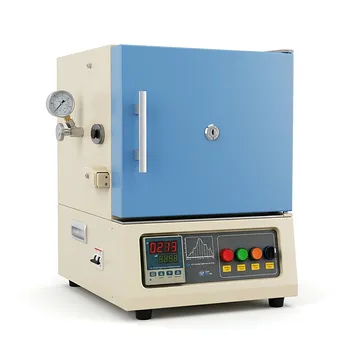
1200C Hybrid Muffle and Tube Furnace for Material Research with Dual Atmosphere Control Quartz Tubes
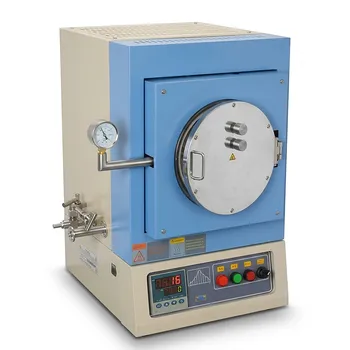
1100°C High Temperature Quartz Chamber Furnace 8 Inch OD with 7.6 Liter Capacity and Vacuum Atmosphere Capability

Vertical 1700C Vacuum and Atmosphere Tube Furnace with 80mm Alumina Tube
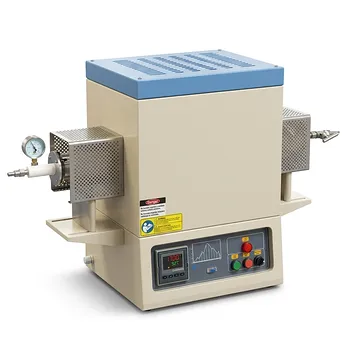
High Temperature Three Zone Tube Furnace 1700C with Alumina Tube and Water Cooled Flanges

Compact High Temperature 1600C Tube Furnace with 50mm Alumina Tube and Vacuum Flanges for Material Sintering

High Temperature 1700C Benchtop Tube Furnace with 5 Inch Heating Zone High Purity Alumina Tube and Vacuum Sealing Flanges

1800C High Temperature Compact Vacuum Tube Furnace with 60mm OD Alumina Tube and Kanthal MoSi2 Heating Elements
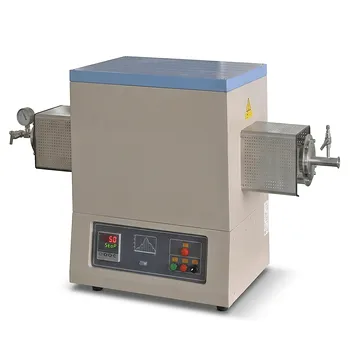
High Temperature 1700C Tube Furnace with 4 Inch OD Alumina Tube and Vacuum Sealing Flanges

High Temperature 1700C Vertical Tube Furnace for Powder Spherification and Material Sintering
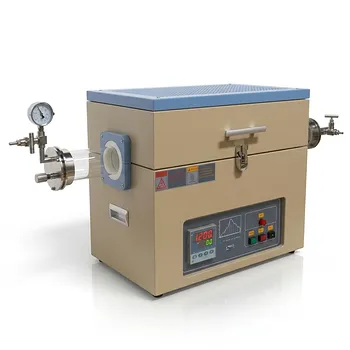
High Temperature 1200C Split Tube Furnace with Optional Quartz Tube Sizes and Vacuum Sealing Flanges for Material Science Research

High Temperature Automated 5 Inch Tube Furnace for Autonomous Material Research and Advanced Laboratory R&D

High Temperature 1700C Six Zone Split Tube Furnace with Alumina Tube and Water Cooled Flanges
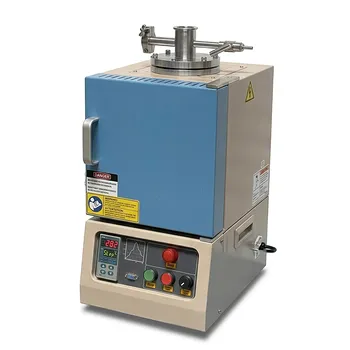
High Temperature Hybrid Muffle and Tube Furnace with Vacuum Capability and PID Control