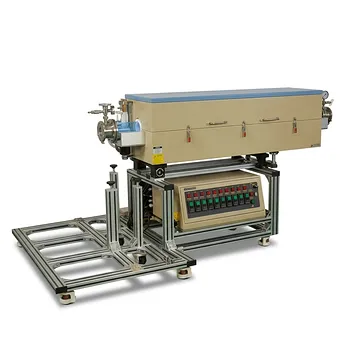
What role does the temperature gradient play in Ta2PdSe6 CVT synthesis? Driving Force for High-Quality Single Crystals
Updated 3 months ago
The temperature gradient is the primary thermodynamic driving force that enables the transport and subsequent crystallization of raw materials into high-quality single crystals. In the synthesis of $\text{Ta}_2\text{PdSe}_6$, the high-temperature tube furnace establishes a precise thermal slope—typically 10 °C/cm—where the source end is maintained at 875 °C and the growth end at 730 °C.
The temperature gradient acts as a kinetic engine, transforming static precursors into volatile intermediate products that migrate across the furnace to recrystallize at the cooler end. Without this precise spatial variation in heat, the chemical transport process would stall, preventing the formation of large-scale, needle-like single crystals.
The Mechanism of Vapor Transport
Driving Molecular Migration
The gradient creates a chemical potential difference between the high-temperature source and the low-temperature growth zone. This difference forces volatile intermediate products, formed by the reaction between raw materials and a transport agent, to move physically through the tube.
Establishing the Growth Environment
At the growth end (730 °C), the lower temperature reduces the solubility of the gaseous species in the vapor phase. This leads to supersaturation, the critical condition required for the gaseous components to precipitate and reorganize into a solid crystal lattice.
Ensuring Kinetic Foundation
The stability of this thermal field provides the physical and kinetic foundation for growth. Consistent temperatures ensure that the rate of material transport matches the rate of crystal attachment, which is essential for producing high-purity, needle-like morphologies.
The Thermodynamic Role of the Tube Furnace
Precise Thermal Field Regulation
A high-precision tube furnace allows for independent control over the source and growth zones. This regulation ensures that the precursors undergo specific physical and chemical transformations only under set conditions, preventing premature deposition.
Vapor Pressure Control
By maintaining a source temperature of 875 °C, the furnace controls the sublimation rate or the reaction rate of the precursors. This ensures a steady supply of gaseous building blocks to the growth zone without overwhelming the crystallization site with too much material at once.
Maintaining Atmospheric Integrity
Beyond heat, the furnace provides a controlled, sealed environment that protects the chemical reactions. This stability is vital for preventing the oxidation of selenium or tantalum and ensuring the final product reaches a single-phase perovskite or chalcogenide structure.
Understanding the Trade-offs
Gradient Steepness vs. Crystal Quality
If the temperature gradient is too steep, the supersaturation levels at the cold end may become too high. This often results in polycrystalline growth or small, disordered crystals rather than the desired large-scale needle structures.
Insufficient Thermal Driving Force
Conversely, a gradient that is too shallow may fail to provide enough thermodynamic "push" to transport the material efficiently. This leads to extremely slow growth rates and may result in crystals that are too small for practical application or characterization.
Impact of Thermal Fluctuations
Any instability in the furnace’s temperature control can cause step defects or inclusions within the crystal. High-quality synthesis requires a furnace capable of maintaining a constant temperature curve over several days or weeks to ensure lattice perfection.
How to Apply This to Your Synthesis Goal
Making the Right Choice for Your Goal
To achieve the best results in CVT synthesis, you must tailor the furnace parameters to the specific requirements of your material's phase diagram.
- If your primary focus is crystal size: Maintain a stable, moderate gradient (near 10 °C/cm) over an extended period to allow for slow, continuous growth.
- If your primary focus is phase purity: Ensure the furnace sealing is absolute and the source temperature is precisely calibrated to avoid the volatilization of unwanted secondary phases.
- If your primary focus is controlling morphology: Adjust the growth zone temperature slightly to find the "sweet spot" where needle-like growth is kinetically favored over bulk growth.
By mastering the precise control of the temperature gradient, you transform a simple heating element into a sophisticated tool for molecular architecture.
Summary Table:
| Parameter | Targeted Value / Detail | Role in CVT Synthesis |
|---|---|---|
| Source Zone Temp | 875 °C | Facilitates sublimation and formation of volatile precursors |
| Growth Zone Temp | 730 °C | Creates supersaturation for precipitation and crystallization |
| Temperature Gradient | ~10 °C/cm | Acts as the thermodynamic driving force for molecular migration |
| Morphology Control | Needle-like structures | Regulated by matching transport rate with attachment rate |
| Atmosphere | Sealed / Controlled | Prevents oxidation and ensures single-phase purity |
Achieve Perfection in Crystal Growth with THERMUNITS
Precision thermal control is the difference between a failed experiment and a high-purity single crystal. THERMUNITS is a leading manufacturer dedicated to supporting material science and industrial R&D with high-performance laboratory equipment.
Our specialized Tube Furnaces are designed to provide the ultra-stable temperature gradients essential for Chemical Vapor Transport (CVT) and CVD/PECVD applications. Beyond tube furnaces, we offer a comprehensive suite of solutions including:
- Muffle, Vacuum, and Atmosphere Furnaces
- Rotary and Hot Press Furnaces
- Vacuum Induction Melting (VIM) and Dental Furnaces
- High-Quality Thermal Elements and Heat Treatment Equipment
Ready to elevate your research with industry-leading thermal stability? Contact THERMUNITS today to find the perfect furnace for your specific synthesis goals.
References
- Fumiaki Kato, Ichiro Terasaki. Enhanced Cryogenic Thermoelectricity in Semimetal Ta<sub>2</sub>PdSe<sub>6</sub> through Non‐Fermi Liquid‐Like Charge and Heat Transport. DOI: 10.1002/apxr.202400063
Mentioned Products
- High Temperature Tube Furnace 1500C with Sliding Flanges and 50mm OD for Rapid Thermal Processing Fast Heating and Cooling
- High Temperature 1700C Tube Furnace with High Vacuum Turbomolecular Pump System and Multi Channel Mass Flow Controller Gas Mixer
- High Temperature 1700C Benchtop Tube Furnace with 5 Inch Heating Zone High Purity Alumina Tube and Vacuum Sealing Flanges
- 1750°C High Temperature Benchtop Vacuum Atmosphere Tube Furnace with Kanthal Super 1800 Heating Elements and 60mm Alumina Processing Tube
- Compact High Temperature 1600C Tube Furnace with 50mm Alumina Tube and Vacuum Flanges for Material Sintering
People Also Ask
- How are high-temperature tube furnaces utilized to repair etching damage? Precision Lattice Restoration Solutions
- What core conditions does a high-temperature tube furnace provide for rGO aerogels? Mastering Precision Synthesis.
- What role does a high-temperature tube furnace play in CVD synthesis of silicon nanowires? Master VLS Growth Precision.
- How does precision tube furnace control influence CoFe nanoparticle formation? Master Your Bimetallic Synthesis.
- What role does a high-temperature tube furnace play in the sulfidation heat treatment of CoS@C/MXene nanocomposites? Guide

Tech Team · ThermUnits
Last updated on Jun 03, 2026
Related Products

High Temperature Tube Furnace 1500C with Sliding Flanges and 50mm OD for Rapid Thermal Processing Fast Heating and Cooling

High Temperature 1700C Tube Furnace with High Vacuum Turbomolecular Pump System and Multi Channel Mass Flow Controller Gas Mixer

High Temperature 1700C Benchtop Tube Furnace with 5 Inch Heating Zone High Purity Alumina Tube and Vacuum Sealing Flanges

1750°C High Temperature Benchtop Vacuum Atmosphere Tube Furnace with Kanthal Super 1800 Heating Elements and 60mm Alumina Processing Tube

Compact High Temperature 1600C Tube Furnace with 50mm Alumina Tube and Vacuum Flanges for Material Sintering

1700C High Temperature Alumina Tube Furnace with 18 Inch Heated Zone and Vacuum Sealing Flanges

1800C High Temperature Compact Vacuum Tube Furnace with 60mm OD Alumina Tube and Kanthal MoSi2 Heating Elements
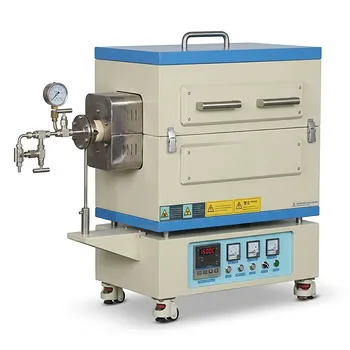
High Temperature Split Tube Furnace 1500C for Material Research Vacuum and Atmosphere Thermal Processing

High Temperature 1700C Vertical Tube Furnace for Powder Spherification and Material Sintering
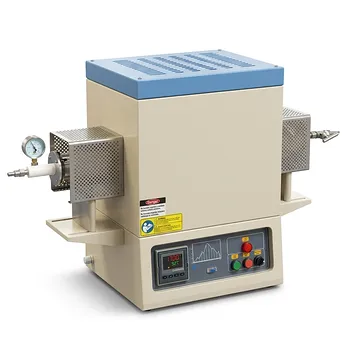
High Temperature Three Zone Tube Furnace 1700C with Alumina Tube and Water Cooled Flanges

High Temperature 1700C Six Zone Split Tube Furnace with Alumina Tube and Water Cooled Flanges
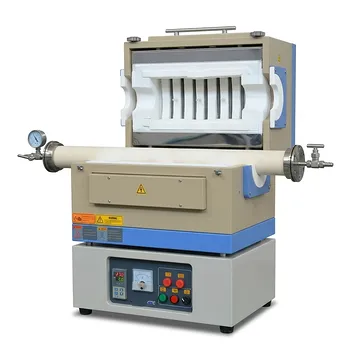
High Temperature 1600C Split Tube Furnace Vacuum Flanges Valves Optional 60mm 80mm Alumina Tube

High Temperature Automated 5 Inch Tube Furnace for Autonomous Material Research and Advanced Laboratory R&D

1100C Tube Furnace with Vacuum Flange and Programmable Temperature Controller for Material Science and Industrial Heat Treatment
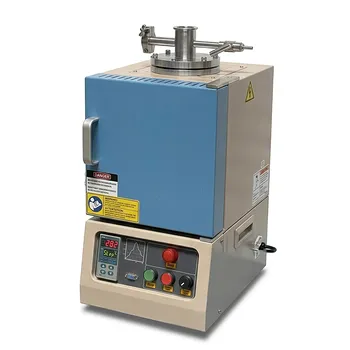
High Temperature Hybrid Muffle and Tube Furnace with Vacuum Capability and PID Control
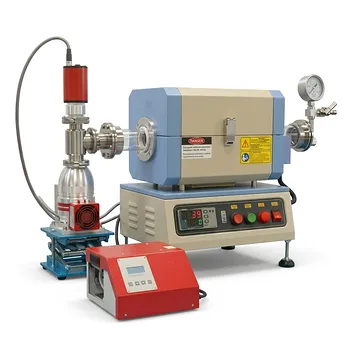
High Vacuum Compact Tube Furnace 1200C with Integrated Turbo Pump System and 8 Inch Heating Zone
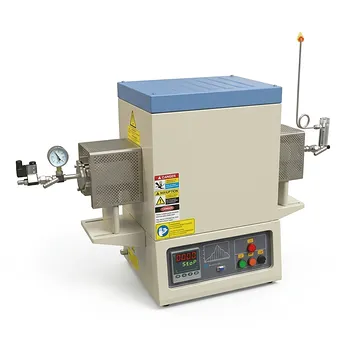
1700C Hydrogen Gas Tube Furnace with 60mm Alumina Process Tube and Integrated Hydrogen Safety Detector

1100°C High Temperature Quartz Chamber Furnace 8 Inch OD with 7.6 Liter Capacity and Vacuum Atmosphere Capability
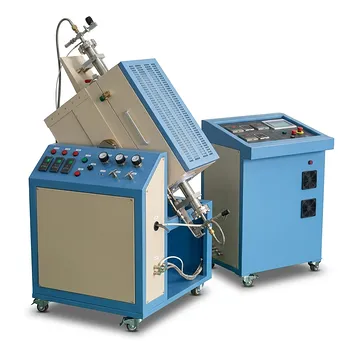
1100C High Pressure Rocking Tube Furnace with 2 Inch Super Alloy Processing Tube for Material Synthesis