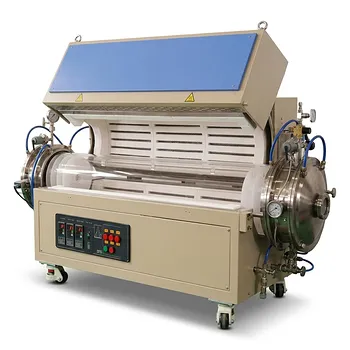
Why is a programmable temperature control tube furnace considered the core equipment for the aerosol-assisted ITC process?
Updated 3 months ago
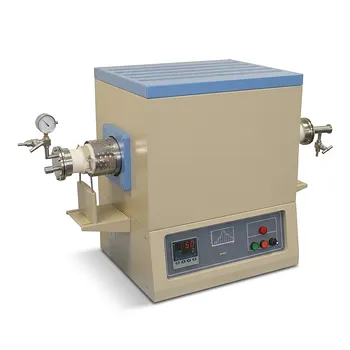
The programmable temperature control tube furnace serves as the foundational engine for aerosol-assisted inverse temperature crystallization (ITC). It provides the precise, uniform thermal environment—often maintained at specific points like 150 °C—required to trigger rapid solvent volatilization and the direct precipitation of solid microcrystals from precursor droplets. By leveraging the unique inverse solubility characteristics of materials like perovskites, the furnace transforms a flowing aerosol stream into high-quality solid-state products during gas-phase transport.
The furnace is the core of the ITC process because it orchestrates the delicate thermodynamic balance required to convert liquid precursors into solid microcrystals mid-flight. Its ability to maintain uniform heat and specific temperature gradients ensures consistent phase transformations while preventing the structural degradation of the material.
Orchestrating the ITC Phase Transformation
Harnessing Inverse Solubility
Unlike most substances, materials used in ITC become less soluble as the temperature increases. The tube furnace provides the constant high-temperature field necessary to exploit this property, forcing the material to precipitate out of the solvent as it heats up.
Facilitating Rapid Volatilization
As precursor droplets move through the furnace, the uniform heat causes the solvent to evaporate rapidly. This speed is critical for direct precipitation, allowing solid microcrystals to form while the material is still in gas-phase transport.
Maintaining Thermodynamic Consistency
The furnace ensures a stable environment where physical and chemical parameters remain constant. This consistency is vital for achieving high-quality output and ensuring that every particle in the aerosol stream undergoes the same transformation process.
The Importance of Precision Programming
Controlling Heating and Cooling Rates
Programmable furnaces allow for strict regulation of thermal ramps, such as a heating rate of 2°C per minute or a cooling rate of 5°C per minute. This precision is essential for maintaining the original skeleton structure of sensitive materials like Metal-Organic Frameworks (MOFs).
Preventing Morphological Loss
Uncontrolled temperature fluctuations can lead to grain coarsening or the loss of specific shapes, such as fiber-stacked microspheres. A programmable furnace mitigates these risks by following a strictly defined thermal curve.
Managing Phase Transitions
High-precision control enables the material to follow specific cooling curves, such as cooling YBCO-358 to a 500°C isothermal hold. This prevents micro-cracks caused by temperature gradients and ensures the structural transformation into the desired phase.
Environmental and Atmospheric Protection
Preventing Oxidation and Contamination
Tube furnaces allow for the integration of vacuum systems or specific atmospheric environments. By shielding materials from the open air, the furnace prevents oxidation and contamination, safeguarding the structural integrity of the final product.
Optimizing Chemical Absorption
Specific temperature zones within the furnace can be used to ensure materials fully absorb necessary elements, such as oxygen. This is critical for materials that require specific chemical saturations to achieve superior performance indicators.
Understanding the Trade-offs
The Risk of Excessive Gradients
While rapid heating is often desired, excessive temperature gradients can introduce internal stress. This often results in micro-cracks or structural failure if the cooling curve is not managed with extreme precision.
Complexity of Isothermal Holds
Implementing extended isothermal holds requires advanced programming to ensure the temperature does not drift. Even minor deviations during these holds can stall phase transformations or lead to inconsistent crystal growth across a batch.
Atmospheric Limitations
While the furnace provides a controlled environment, the interaction between the aerosol stream and the furnace walls must be managed. Failure to maintain a clean tube or a stable vacuum can introduce impurities that negate the benefits of the precise temperature control.
How to Apply This to Your Project
When selecting or programming a tube furnace for aerosol-assisted ITC, your technical requirements should dictate your configuration:
- If your primary focus is Morphological Precision: Prioritize a furnace with high-precision PID controllers to maintain strict heating rates and prevent grain coarsening.
- If your primary focus is Material Purity: Ensure the furnace is equipped for an adjustable vacuum or specific gas atmosphere to prevent oxidation at high temperatures.
- If your primary focus is Structural Integrity: Use programmable cooling curves with isothermal holds to prevent micro-cracks and ensure complete phase transformation.
Mastering the programmable temperature control tube furnace is not merely about applying heat, but about precisely managing the thermodynamic journey of the material to ensure structural and functional excellence.
Summary Table:
| Feature | Benefit to ITC Process | Impact on Material Quality |
|---|---|---|
| Precise PID Control | Maintains strict heating/cooling ramps | Prevents grain coarsening & structural loss |
| Uniform Thermal Field | Facilitates rapid solvent volatilization | Ensures consistent phase transformation |
| Atmospheric Shielding | Vacuum or inert gas integration | Prevents oxidation and chemical contamination |
| Programmable Curves | Manages isothermal holds & gradients | Eliminates micro-cracks and internal stress |
Elevate Your R&D with Precision Thermal Solutions
At THERMUNITS, we understand that the success of aerosol-assisted inverse temperature crystallization (ITC) depends on absolute thermal precision. As a leading manufacturer of high-temperature laboratory equipment, we provide the advanced tools researchers need to achieve structural and functional excellence in material science.
Our comprehensive range of thermal processing solutions includes:
- Tube & Rotary Furnaces for seamless gas-phase transport and ITC.
- Vacuum & Atmosphere Furnaces to protect sensitive materials from oxidation.
- Muffle, Dental, and Hot Press Furnaces for diverse heat treatment needs.
- CVD/PECVD Systems and Vacuum Induction Melting (VIM) Furnaces.
Whether you are refining perovskites or developing complex MOFs, our programmable equipment ensures the thermodynamic consistency your project demands. Contact our technical team today to find the perfect furnace configuration for your laboratory.
References
- Ulrich Bahnmüller, Sebastian Polarz. One‐Step Aerosol Synthesis of Thiocyanate Passivated Hybrid Perovskite Microcrystals: Impact of (Pseudo‐)Halide Additives on Crystallization and Access to a Novel Binary Model. DOI: 10.1002/ppsc.202400132
Mentioned Products
- 1100C Tube Furnace with Vacuum Flange and Programmable Temperature Controller for Material Science and Industrial Heat Treatment
- 1250C Compact Split Tube Furnace with 8 Inch Heating Zone and Programmable Controller
- Double Temperature Zone Double Cover Tube Furnace for High Temperature CVD and Vacuum Annealing
- High Temperature Dual Zone Tube Furnace for Material Science Research and Professional Thermal Processing
- High Temperature Hybrid Muffle and Tube Furnace with Vacuum Capability and PID Control
People Also Ask
- What are the advantages of 1100°C tube furnaces for ORR catalysts? Boost Conductivity and Structural Stability.
- What role does a tube furnace play in PS template removal? Ensure ZnO/SiO2 Structural Integrity & High Performance.
- What core functions does a high-temperature vacuum tube furnace provide? Optimize np-CuSn Sintering & Joint Integrity
- What is the role of a high-temperature tube furnace in the calcination process of ZnO/In2O3 nanocomposites?
- What impact does the heating rate of a tube furnace have on biochar microstructure? Optimize Your Material R&D.

Tech Team · ThermUnits
Last updated on Jun 03, 2026
Related Products

1100C Tube Furnace with Vacuum Flange and Programmable Temperature Controller for Material Science and Industrial Heat Treatment
1250C Compact Split Tube Furnace with 8 Inch Heating Zone and Programmable Controller
Double Temperature Zone Double Cover Tube Furnace for High Temperature CVD and Vacuum Annealing
High Temperature Dual Zone Tube Furnace for Material Science Research and Professional Thermal Processing
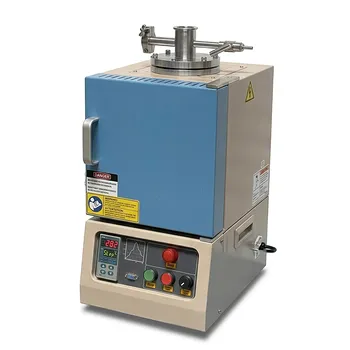
High Temperature Hybrid Muffle and Tube Furnace with Vacuum Capability and PID Control
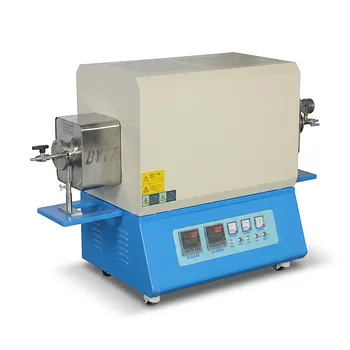
High Temperature Dual Zone Split Tube Furnace for Advanced Atmosphere Sintering and Vacuum CVD Applications
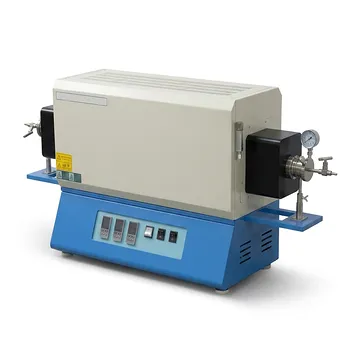
High Temperature Three Temperature Zone Tube Furnace for Advanced Material Science Sintering and Chemical Vapor Deposition Applications
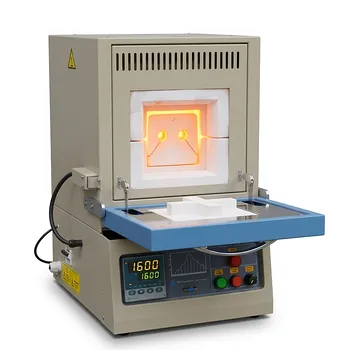
High Temperature Compact Muffle Furnace 1700 C with 30 Segment Programmable Controller and 1.7L Cubic Chamber
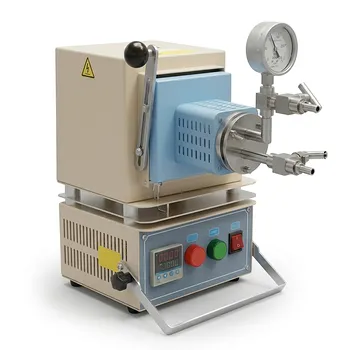
Compact Hybrid Muffle and Tube Furnace for 1000C Controlled Atmosphere Laboratory Material Sintering

High Temperature 1700C Vertical Tube Furnace for Powder Spherification and Material Sintering

Compact Vertical Split Quartz Tube Furnace with Stainless Steel Vacuum Flanges for Rapid Thermal Quenching and Controlled Atmosphere Material Processing

High Temperature 1700C Tube Furnace with High Vacuum Turbomolecular Pump System and Multi Channel Mass Flow Controller Gas Mixer
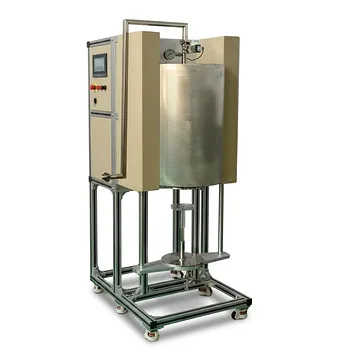
1200°C Atmosphere Controlled Automatic Bottom Loading Furnace with 6 Inch Quartz Tube

High Temperature Automated 5 Inch Tube Furnace for Autonomous Material Research and Advanced Laboratory R&D
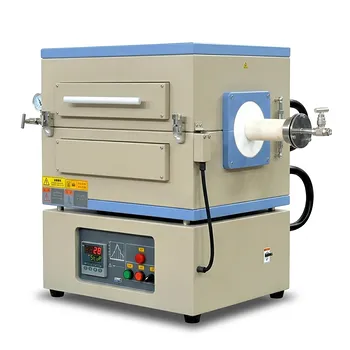
1500°C Split Tube Furnace with Alumina Tube and Vacuum Sealing Flanges for Material Research
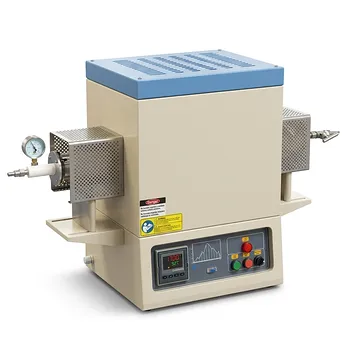
High Temperature Three Zone Tube Furnace 1700C with Alumina Tube and Water Cooled Flanges

High Temperature 1700C Six Zone Split Tube Furnace with Alumina Tube and Water Cooled Flanges

Compact High Temperature 1600C Tube Furnace with 50mm Alumina Tube and Vacuum Flanges for Material Sintering
1700C High Temperature Alumina Tube Furnace with 18 Inch Heated Zone and Vacuum Sealing Flanges