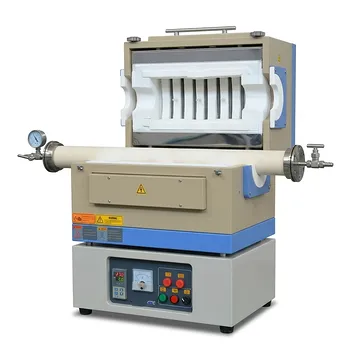
How does a high vacuum tube furnace facilitate regional selective growth of perovskite films? Master Precise SEAPVD
Updated 3 months ago
The high vacuum tube furnace is the fundamental hardware that enables the precise control required for Surface Energy-Assisted Physical Vapor Deposition (SEAPVD). It functions by sublimating perovskite source powders in a high-temperature zone and utilizing a carrier gas to transport these vapors across a temperature gradient to a target substrate. The furnace environment ensures that nucleation occurs exclusively in specific, high-surface-energy regions, allowing for the creation of highly ordered, patterned perovskite films.
Core Takeaway: A high vacuum tube furnace facilitates SEAPVD by creating a synchronized environment of low pressure and controlled thermal gradients. This allows for the efficient sublimation of precursors and directs their deposition onto specific substrate patterns based on surface energy differentials.
The Role of the Controlled Thermal Environment
Sublimation in the High-Temperature Zone
The furnace provides a localized heating zone where perovskite source powders reach their sublimation point. By maintaining temperatures—often around 500°C or higher depending on the material—the furnace converts solid precursors into a stable gas phase.
Establishing the Temperature Gradient
A critical function of the tube furnace is the creation of a thermal field that decreases from the center to the downstream end. This gradient is the driving force for supersaturation, which dictates the transition of the vapor back into a solid state upon reaching the cooler substrate.
Enhancing Vaporization via Vacuum
The vacuum system maintains a low-pressure environment (often near $10^3$ Pascals), which effectively lowers the boiling point of organic salt precursors. This facilitates deep diffusion of molecules into the template lattice and prevents the high vapor pressures that could damage the delicate perovskite structure.
Mechanisms of Vapor Transport and Selective Growth
Mass Transfer via Carrier Gas
The furnace uses a precise flow of Argon (Ar) gas to move sublimated components toward the substrate. This carrier gas ensures a steady supply of precursors to the growth zone, maintaining the stoichiometry required for high-quality film formation.
Exploiting Surface Energy Differentials
The SEAPVD process relies on the substrate having regions of varying surface energy. The tube furnace's stable environment allows perovskite molecules to "select" areas with higher surface energy for preferential nucleation, effectively using the substrate's own physics to pattern the film.
Achieving High Crystallinity
By providing a uniform thermal field, the furnace ensures that the resulting films possess large-area continuity and high phase purity. This precision is essential for the material to exhibit the desired fluorescence and electronic properties.
Understanding the Trade-offs
Vapor Pressure vs. Structural Integrity
While low pressure accelerates vaporization, excessive vapor pressure within the tube can lead to structural damage of the lead halide template. Balancing the vacuum level is a delicate trade-off between deposition speed and film smoothness.
Thermal Lag and Stoichiometry
In dual-zone furnaces, different precursors (like MAI and lead acetate) have different sublimation characteristics. If the temperature gradients are not perfectly synchronized, the resulting film may suffer from poor stoichiometry or unwanted phases.
Atmosphere Sensitivity
Perovskite materials are often sensitive to oxygen and moisture. The sealing performance of the tube furnace is a double-edged sword: while it protects the material, any leak in the high-vacuum seals can lead to the oxidation of metallic components and total film degradation.
How to Apply This to Your Project
Making the Right Choice for Your Goal
To achieve the best results with a high vacuum tube furnace in SEAPVD, your operational focus must align with your specific material requirements:
- If your primary focus is high-resolution patterning: Prioritize the precision of the substrate surface energy treatment and maintain a slower carrier gas flow to allow for selective nucleation.
- If your primary focus is film crystallinity and grain size: Focus on optimizing the dual-zone temperature profile to ensure a steady, uniform supersaturation gradient throughout the deposition.
- If your primary focus is preventing material degradation: Ensure the vacuum system and gas purification are capable of maintaining an oxygen-free, reductive atmosphere (such as Ar/H2 mixes).
Mastering the interplay between vacuum-assisted sublimation and surface energy-driven nucleation is the key to unlocking the full potential of vapor-phase perovskite manufacturing.
Summary Table:
| Feature | Role in SEAPVD Process | Key Benefit |
|---|---|---|
| High-Temp Zone | Sublimates source powders | Stable precursor gas phase |
| Thermal Gradient | Drives vapor supersaturation | Controlled regional nucleation |
| Vacuum System | Lowers precursor boiling points | Prevents structural damage to lattice |
| Carrier Gas (Ar) | Mass transfer of vapors | Maintains chemical stoichiometry |
| Uniform Field | Thermal stabilization | High crystallinity and phase purity |
Elevate your material science research with THERMUNITS, a premier manufacturer of high-temperature laboratory equipment. Our specialized high vacuum tube furnaces, CVD/PECVD systems, and atmosphere furnaces are engineered to deliver the precision required for complex SEAPVD and perovskite film growth. Whether you need muffle, rotary, dental, or hot press furnaces, our comprehensive thermal solutions ensure superior heat treatment results for industrial R&D.
Consult with our experts today to find the perfect furnace for your project!
References
- Zhangsheng Xu, Caofeng Pan. Surface Energy‐Assisted Patterning of Vapor Deposited All‐Inorganic Perovskite Arrays for Wearable Optoelectronics. DOI: 10.1002/advs.202402635
Mentioned Products
- 1800C High Temperature Compact Vacuum Tube Furnace with 60mm OD Alumina Tube and Kanthal MoSi2 Heating Elements
- 1750°C High Temperature Benchtop Vacuum Atmosphere Tube Furnace with Kanthal Super 1800 Heating Elements and 60mm Alumina Processing Tube
- High Vacuum Compact Tube Furnace 1200C with Integrated Turbo Pump System and 8 Inch Heating Zone
- High Temperature 1700C Tube Furnace with High Vacuum Turbomolecular Pump System and Multi Channel Mass Flow Controller Gas Mixer
- 1200C High Temperature 5 Inch Split Vacuum Tube Furnace with 12 Inch Heating Zone and Separated PID Controller
People Also Ask
- What core functions does a high-temperature vacuum tube furnace provide? Optimize np-CuSn Sintering & Joint Integrity
- What impact does the heating rate of a tube furnace have on biochar microstructure? Optimize Your Material R&D.
- What is the primary function of a high-temperature tube furnace in Cu1-N-C synthesis? Precision Thermal Control.
- How does a tube furnace facilitate CrMnFeCoCu alloy conversion? Master High-Entropy Oxide Synthesis with THERMUNITS.
- What is the function of a high-temperature tube furnace in the annealing of Ni-N-C composites? Optimize Catalyst Synthesis

Tech Team · ThermUnits
Last updated on Jun 02, 2026
Related Products

1800C High Temperature Compact Vacuum Tube Furnace with 60mm OD Alumina Tube and Kanthal MoSi2 Heating Elements

1750°C High Temperature Benchtop Vacuum Atmosphere Tube Furnace with Kanthal Super 1800 Heating Elements and 60mm Alumina Processing Tube
High Vacuum Compact Tube Furnace 1200C with Integrated Turbo Pump System and 8 Inch Heating Zone

High Temperature 1700C Tube Furnace with High Vacuum Turbomolecular Pump System and Multi Channel Mass Flow Controller Gas Mixer
1200C High Temperature 5 Inch Split Vacuum Tube Furnace with 12 Inch Heating Zone and Separated PID Controller
High Temperature 1100C Compact Top Loading Vertical Vacuum Tube Furnace for High Vacuum Noble Metal Melting and Material Research
High Temperature Compact Vacuum Tube Furnace 1750C Max 60mm OD Alumina Tube
High Temperature Dual Zone Vacuum Tube Furnace for Material Research and CVD Processing

Compact High Temperature 1600C Tube Furnace with 50mm Alumina Tube and Vacuum Flanges for Material Sintering

High Temperature 1700C Benchtop Tube Furnace with 5 Inch Heating Zone High Purity Alumina Tube and Vacuum Sealing Flanges

High Temperature Automated 5 Inch Tube Furnace for Autonomous Material Research and Advanced Laboratory R&D

1100C Tube Furnace with Vacuum Flange and Programmable Temperature Controller for Material Science and Industrial Heat Treatment
500C Vacuum Vertical Tube Furnace 84mm OD Sample Rotation Lifting System

High Temperature 1700C Vertical Tube Furnace for Powder Spherification and Material Sintering

1100°C High Temperature Quartz Chamber Furnace 8 Inch OD with 7.6 Liter Capacity and Vacuum Atmosphere Capability
Vertical Openable Tube Furnace 0-1700c High Temperature Laboratory System for CVD and Vacuum Heat Treatment
High Temperature Hybrid Muffle and Tube Furnace with Vacuum Capability and PID Control

High Temperature 1700C Six Zone Split Tube Furnace with Alumina Tube and Water Cooled Flanges
1250C Split Tube Furnace with 3 Inch Mullite Tube and Vacuum Sealing Flanges for Precision Thermal Processing