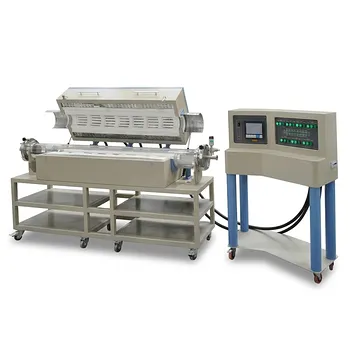
How does a two-zone tube furnace control the quality of Tungsten Diselenide (WSe2)? Optimize Your 2D Material Synthesis
Updated 3 months ago
The two-zone tube furnace controls the quality of Tungsten Diselenide ($WSe_2$) by decoupling the vaporization of the selenium source from the chemical reaction on the substrate. This independent control allows for the precise regulation of selenium vapor pressure upstream and reaction temperature downstream, ensuring stable kinetics for the growth of large-grain, layered van der Waals structures.
Core Takeaway: A two-zone furnace provides the essential "process decoupling" needed to balance precursor concentration and reaction energy. By managing these variables separately, it ensures high crystallinity, protects the lattice structure, and dictates whether the film grows horizontally or vertically.
Achieving Process Decoupling through Independent Zones
Upstream Control of Selenium Vapor
The upstream heating zone is dedicated exclusively to the vaporization of solid selenium pellets. By controlling this zone independently, the furnace maintains a saturated selenium vapor pressure without being influenced by the higher temperatures required for the reaction itself.
Downstream Regulation of the Selenization Reaction
The downstream "main" zone provides the thermal energy required for the tungsten-selenium reaction, often maintained at approximately 900°C. This separation ensures that the substrate receives a steady flow of precursor, preventing the depletion or surging of reactants that leads to defects.
Synthesis of Large-Grain Structures
The stability afforded by this dual-zone mechanism is the physical foundation for high-quality $WSe_2$. It allows for the slow, controlled growth necessary to form large grains and the characteristic layered van der Waals structure critical for optoelectronic performance.
Managing Growth Orientation and Kinetics
Controlling Horizontal vs. Vertical Growth
Temperature precision dictates the growth mode of the thin film. Temperatures below 950°C typically encourage horizontal growth along the substrate, while temperatures exceeding 1000°C can induce rapid reactions and precursor evaporation that transition the film toward vertical growth.
Regulating Reaction Atmospheres
The furnace maintains a strictly controlled environment, often utilizing an $Ar+H_2$ (5%) mixed gas to create a reductive and inert atmosphere. This prevents the oxidation of the tungsten source and ensures a stable kinetic environment for the chemical conversion process.
Pressure and Flow Dynamics
The furnace’s vacuum and pressure systems regulate the evaporation rate of the selenium. By managing internal pressure and stable carrier gas flow (such as Argon), the furnace ensures that the selenization occurs under optimized kinetic conditions for uniform film thickness.
Protecting Structural Integrity via Thermal Control
Programmed Cooling and Stress Relief
A precise cooling program, such as a rate of 10°C per minute, is vital for maintaining the lattice structure. Controlled cooling allows for the gradual release of internal stresses caused by the different thermal expansion coefficients of the $WSe_2$ and the substrate.
Preventing Lattice Defects and Delamination
By managing the thermal transition, the furnace prevents the thin film from cracking or peeling off the substrate. This protects the integrity of the lattice, reduces defect density, and ensures the stability of the final material in sensor and electronic applications.
Understanding the Trade-offs
Vapor Pressure vs. Substrate Temperature
If the upstream temperature is too high relative to the downstream zone, excessive selenium vapor can lead to non-uniform deposition or unwanted multi-layer clusters. Conversely, if the upstream temperature is too low, the resulting vapor pressure may be insufficient to complete the selenization of the tungsten precursor.
Growth Speed vs. Structural Quality
Higher temperatures in the downstream zone can accelerate production but risk transitioning the film to vertical growth, which may be undesirable for certain electronic applications. Rapid growth often comes at the expense of grain size, potentially increasing the number of grain boundaries and reducing charge carrier mobility.
Applying This to Your Material Synthesis
When configuring a two-zone furnace for $WSe_2$ production, your temperature profile should be dictated by the specific requirements of your end application.
- If your primary focus is high charge carrier mobility: Prioritize horizontal growth by keeping the downstream temperature below 950°C and utilizing a slow cooling rate to minimize lattice defects.
- If your primary focus is high active surface area (for catalysis): Adjust the downstream zone toward 1000°C to encourage vertical growth, which increases the density of exposed active sites.
- If your primary focus is film uniformity and adhesion: Use a strictly controlled $Ar+H_2$ atmosphere and a low-pressure environment to ensure even precursor distribution and stable reaction kinetics.
Precision in decoupling vaporization from reaction is the definitive factor in transforming a raw precursor into a high-performance semiconductor thin film.
Summary Table:
| Control Factor | Primary Function | Impact on WSe2 Quality |
|---|---|---|
| Upstream Zone | Selenium Vaporization | Maintains saturated vapor pressure; prevents precursor surges or depletion. |
| Downstream Zone | Substrate Reaction | Regulates reaction kinetics and determines horizontal vs. vertical growth orientation. |
| Atmosphere (Ar+H2) | Reductive Environment | Prevents oxidation of the tungsten source; ensures stable chemical conversion. |
| Cooling Program | Stress Relief | Prevents lattice defects, cracking, and delamination via gradual thermal transition. |
Optimize Your Material Research with THERMUNITS
As a global leader in high-temperature laboratory equipment for material science, THERMUNITS offers the precision required for advanced WSe2 synthesis and semiconductor R&D. Our expert-engineered thermal solutions—including Tube, Muffle, Vacuum, Atmosphere, and Rotary Furnaces, as well as CVD/PECVD systems, Dental Furnaces, and Hot Press furnaces—provide the independent zone control and atmosphere stability essential for high-performance heat treatment.
Whether you are focusing on high charge carrier mobility or maximizing active surface area for catalysis, our equipment ensures reproducible results and superior material integrity.
Connect with THERMUNITS Experts Today to discuss your specific high-temperature processing requirements and elevate your lab’s efficiency.
References
- Kathryn M. Neilson, Eric Pop. Toward Mass Production of Transition Metal Dichalcogenide Solar Cells: Scalable Growth of Photovoltaic-Grade Multilayer WSe<sub>2</sub> by Tungsten Selenization. DOI: 10.1021/acsnano.4c03590
Mentioned Products
- Two Zone Rotary Tube Furnace for Powder CVD Coating and Core Shell Material Synthesis 1100C
- 1500C Two Zone Split Tube Furnace with Vacuum Flange and 80mm Alumina Tube
- Dual Zone Tube Furnace 1100C with 11 Inch Quartz Tube and Vacuum Flanges for 8 Inch Wafer Processing
- Two Zone IR Heating Rapid Thermal Processing RTP Tube Furnace with 4 Inch ID Quartz Tube and Sliding Sample Holders
- Elongated Two Temperature Zone Pipe Furnace for Industrial Heat Treatment and Material Science Research
People Also Ask
- What is the function of a two-zone furnace in SCA-CVD? Mastering Thermal Gradients for Atomic-Scale MOF Crystals
- Why is a Tube Furnace typically utilized for CVD? Achieve Precision in Graphene and 2D Material Synthesis
- How does a rotary tube furnace improve the processing of granular materials? Enhance Uniformity and Reaction Kinetics
- Why is the precise optimization of residence time essential in the catalyst calcination process? Maximize Your Yields.
- In what ways do rotary tube furnaces enhance chemical and specialty mineral processing? Drive Precision and Uniformity.

Tech Team · ThermUnits
Last updated on Jun 02, 2026
Related Products
Two Zone Rotary Tube Furnace for Powder CVD Coating and Core Shell Material Synthesis 1100C
1500C Two Zone Split Tube Furnace with Vacuum Flange and 80mm Alumina Tube
Dual Zone Tube Furnace 1100C with 11 Inch Quartz Tube and Vacuum Flanges for 8 Inch Wafer Processing
Two Zone IR Heating Rapid Thermal Processing RTP Tube Furnace with 4 Inch ID Quartz Tube and Sliding Sample Holders
Elongated Two Temperature Zone Pipe Furnace for Industrial Heat Treatment and Material Science Research
High Temperature Elongated Dual Zone Tube Furnace for Material Research and Industrial Heat Treatment
Dual Heating Zone 1200C Compact Split Tube Furnace with Optional 1" - 2" Tube and Vacuum Flanges
1200C Dual Temperature Zone Slidable Tube Furnace for 2D Material Growth and TCVD Synthesis
1200C Dual Zone Split Tube Furnace with Fused Quartz Tube and Vacuum Flanges Available in 60mm 80mm and 100mm Diameters
Dual Zone Quartz Tube Furnace with 80mm Diameter 1200C Max Temperature 3 Channel Gas Mixer and Vacuum Pump System
Dual Zone Split Tube Quenching Furnace with High Vacuum Atmosphere Control and Rapid Cooling
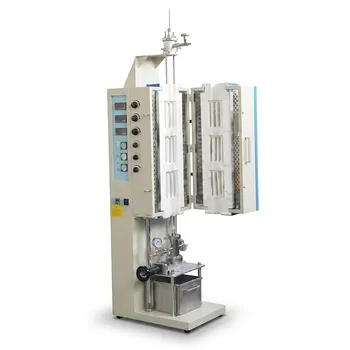
High Temperature Dual Zone Tube Furnace for Material Science Research and Professional Thermal Processing
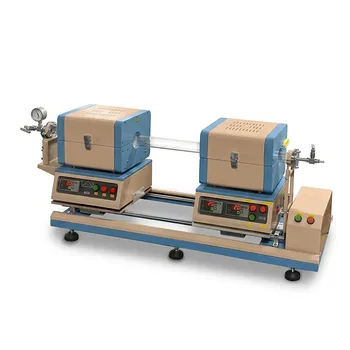
High Temperature 1200C Automatic Sliding Dual Zone Tube Furnace for 2D Transition Metal Dichalcogenides Growth and Material Sublimation Research
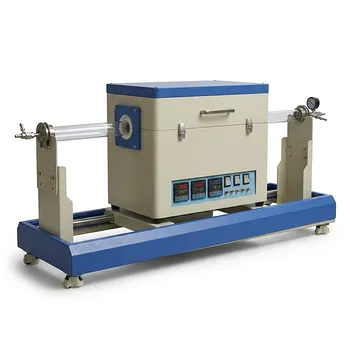
Double Temperature Zone Double Cover Tube Furnace for High Temperature CVD and Vacuum Annealing
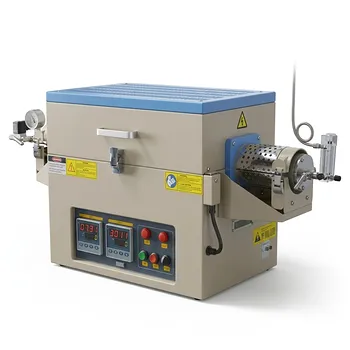
1100C Dual Zone Hydrogen Gas Tube Furnace with Quartz Tube and Integrated H2 Leak Detection System
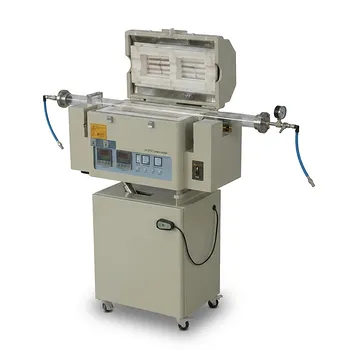
Double Temperature Revolving Tube Furnace with Precision Rotation and Adjustable Inclination for Advanced Material Research
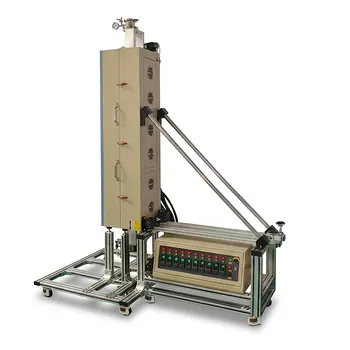
1200°C 10-Zone Split Tube Furnace with Horizontal and Vertical Mounting for Multi-Zone Thermal Gradients and Large Diameter Material Processing
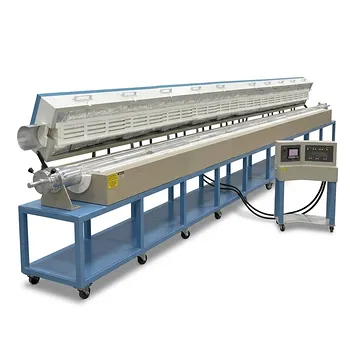
12 Zone Ultra Long Split Tube Furnace with 20 Foot Quartz Tube and 1100C Max Temperature
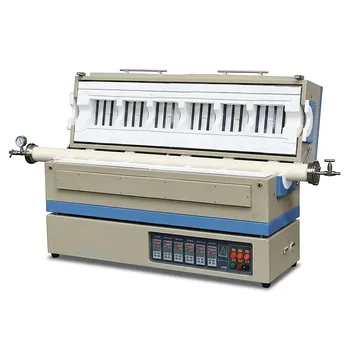
Six Zone Split Tube Furnace with Alumina Tube and Vacuum Flanges for 1500C High Temperature Thermal Processing and CVD