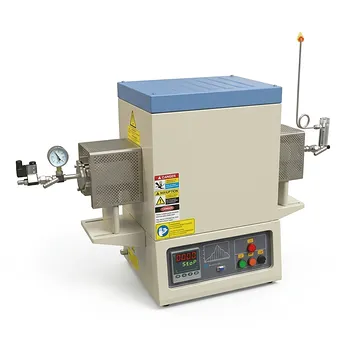
How does the temperature range of a high-temperature tube furnace affect the phase transformation of BiFeO3/Bi25FeO40 heterojunctions?
Updated 3 months ago
The temperature range of a high-temperature tube furnace acts as the primary switch for determining the specific phase composition of Bi-Fe-O heterojunctions. At 600 °C, the furnace environment promotes the formation of $BiFeO_3/Bi_2O_3$ composites. As the temperature is increased to 700 °C and 750 °C, the heightened thermal energy triggers a partial transformation of the $BiFeO_3$ phase into $Bi_{25}FeO_{40}$, creating a distinct heterojunction structure.
This temperature gradient is the decisive factor in engineering the crystal structure of the material. By precisely tuning the thermal energy between 600 °C and 750 °C, researchers can control the ratio of phases to optimize photocatalytic activity.
The Mechanics of Thermally Driven Phase Transformation
600 °C: The Threshold for $BiFeO_3/Bi_2O_3$ Stability
At the lower end of the effective processing range, specifically around 600 °C, the tube furnace provides sufficient energy for calcination without inducing significant secondary transformations.
This temperature favors a stable mixture of $BiFeO_3$ and $Bi_2O_3$. At this stage, the material lacks the specific $Bi_{25}FeO_{40}$ phase required for certain high-performance heterojunction applications.
700 °C – 750 °C: Inducing the $Bi_{25}FeO_{40}$ Transition
Increasing the furnace temperature to 700 °C or 750 °C introduces higher levels of thermal energy into the system. This energy acts as a catalyst for the partial decomposition and restructuring of the $BiFeO_3$ lattice.
The result is the emergence of the $Bi_{25}FeO_{40}$ phase, which grows alongside the remaining $BiFeO_3$. This temperature-dependent transition is what allows for the creation of the $BiFeO_3/Bi_{25}FeO_{40}$ heterojunction interface.
The Role of the Furnace Environment in Phase Control
Synergistic Growth and Atmosphere Interaction
Beyond simple temperature settings, the use of an atmosphere control tube furnace is vital for stabilizing these phases. By introducing a mixed gas of 10% $O_2$ and $Ar$, the furnace creates a controlled redox environment.
This specific atmosphere inhibits the excessive decomposition of $Bi_2O_3$ during the heating process. This ensures that the metastable $BiFeO_3$ and the new $Bi_{25}FeO_{40}$ phase grow together synergistically rather than breaking down into unwanted oxides.
Isothermal Stability and Crystal Quality
High-temperature tube furnaces provide a highly stable isothermal environment that is critical for phase purity. A stable thermal field ensures that atomic diffusion occurs uniformly throughout the precursor material.
This uniformity prevents localized phase imbalances, allowing for the precise regulation of grain size and the resulting magnetic or photocatalytic properties of the heterojunction.
Understanding the Trade-offs
Phase Complexity vs. Stability
While higher temperatures (700 °C+) are necessary to form the $Bi_{25}FeO_{40}$ phase, they also increase the risk of over-transformation. If the temperature exceeds the optimal range or if the dwell time is too long, the heterojunction may lose the beneficial properties of the original $BiFeO_3$ phase.
Atmospheric Sensitivity
The phase transformation is highly sensitive to the surrounding gas. In a standard air environment, the bismuth-iron-oxygen system may behave differently than in a controlled $O_2/Ar$ mix, potentially leading to impurities that degrade the material's semiconductor performance.
Applying Thermal Control to Your Material Goals
Recommendations for Phase Engineering
- If your primary focus is $Bi_2O_3$ integration: Maintain a stable calcination temperature of 600 °C to prevent the transition into $Bi_{25}FeO_{40}$.
- If your primary focus is $BiFeO_3/Bi_{25}FeO_{40}$ heterojunctions: Utilize a temperature range between 700 °C and 750 °C while strictly controlling the $O_2/Ar$ atmosphere to ensure synergistic phase growth.
- If your primary focus is grain size and phase purity: Use a furnace with a proven isothermal stable field to ensure uniform atomic diffusion and prevent amorphous remnants.
Mastering the narrow thermal window between 600 °C and 750 °C allows for the precise architectural design of bismuth-based heterojunctions for advanced technical applications.
Summary Table:
| Temp Range | Resulting Phase Composition | Atmosphere Requirement | Key Thermal Outcome |
|---|---|---|---|
| 600 °C | $BiFeO_3$ / $Bi_2O_3$ | Controlled O2/Ar Mix | High phase stability; prevents $Bi_{25}FeO_{40}$ transition |
| 700 – 750 °C | $BiFeO_3$ / $Bi_{25}FeO_{40}$ | 10% $O_2$ + Ar Mix | Triggers heterojunction growth via partial transformation |
| Above 750 °C | Over-transformation | High Sensitivity | Risk of phase breakdown and loss of semiconductor properties |
Master Precision Phase Engineering with THERMUNITS
At THERMUNITS, we understand that the success of your material science research depends on absolute thermal control. As a leading manufacturer of high-temperature laboratory equipment, we provide the specialized Tube and Atmosphere Furnaces required to achieve the narrow thermal windows necessary for $BiFeO_3/Bi_{25}FeO_{40}$ heterojunction synthesis.
Why partner with THERMUNITS for your R&D?
- Superior Isothermal Stability: Our furnaces ensure uniform heating to prevent localized phase imbalances.
- Advanced Atmosphere Integration: Precisely manage $O_2/Ar$ environments to inhibit unwanted oxide decomposition.
- Comprehensive Solutions: We offer a full range of equipment, including Muffle, Vacuum, Rotary, and Hot Press furnaces, as well as CVD/PECVD systems and Vacuum Induction Melting (VIM) furnaces.
Elevate your laboratory's heat treatment capabilities today. Contact our technical experts here to discuss your specific material goals and find the ideal high-performance furnace for your research.
References
- Yuanjun Song, Tong Zhang. A Simple One-Pot Method for the Synthesis of BiFeO3/Bi25FeO40 Heterojunction for High-Performance Photocatalytic Degradation Applications. DOI: 10.3390/ijms26010196
Mentioned Products
- High Temperature Tube Furnace 1500C with Sliding Flanges and 50mm OD for Rapid Thermal Processing Fast Heating and Cooling
- High Temperature 1700C Tube Furnace with High Vacuum Turbomolecular Pump System and Multi Channel Mass Flow Controller Gas Mixer
- 1750°C High Temperature Benchtop Vacuum Atmosphere Tube Furnace with Kanthal Super 1800 Heating Elements and 60mm Alumina Processing Tube
- High Temperature 1700C Benchtop Tube Furnace with 5 Inch Heating Zone High Purity Alumina Tube and Vacuum Sealing Flanges
- 1700C High Temperature Alumina Tube Furnace with 18 Inch Heated Zone and Vacuum Sealing Flanges
People Also Ask
- How are high-temperature tube furnaces utilized to repair etching damage? Precision Lattice Restoration Solutions
- What core conditions does a high-temperature tube furnace provide for rGO aerogels? Mastering Precision Synthesis.
- What role does a high-temperature tube furnace play in CVD synthesis of silicon nanowires? Master VLS Growth Precision.
- How does precision tube furnace control influence CoFe nanoparticle formation? Master Your Bimetallic Synthesis.
- What role does a high-temperature tube furnace play in the sulfidation heat treatment of CoS@C/MXene nanocomposites? Guide

Tech Team · ThermUnits
Last updated on Jun 03, 2026
Related Products

High Temperature Tube Furnace 1500C with Sliding Flanges and 50mm OD for Rapid Thermal Processing Fast Heating and Cooling

High Temperature 1700C Tube Furnace with High Vacuum Turbomolecular Pump System and Multi Channel Mass Flow Controller Gas Mixer

1750°C High Temperature Benchtop Vacuum Atmosphere Tube Furnace with Kanthal Super 1800 Heating Elements and 60mm Alumina Processing Tube

High Temperature 1700C Benchtop Tube Furnace with 5 Inch Heating Zone High Purity Alumina Tube and Vacuum Sealing Flanges
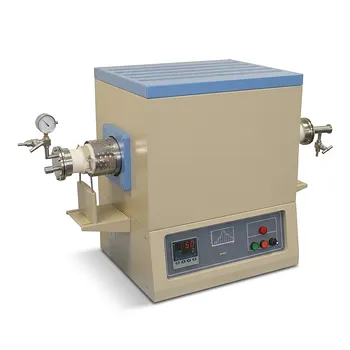
1700C High Temperature Alumina Tube Furnace with 18 Inch Heated Zone and Vacuum Sealing Flanges
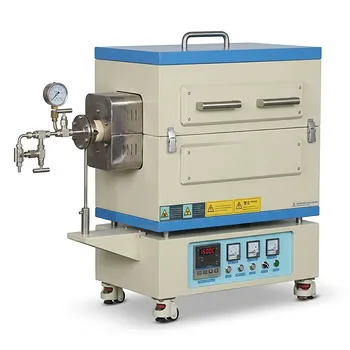
High Temperature Split Tube Furnace 1500C for Material Research Vacuum and Atmosphere Thermal Processing

Compact High Temperature 1600C Tube Furnace with 50mm Alumina Tube and Vacuum Flanges for Material Sintering

1800C High Temperature Compact Vacuum Tube Furnace with 60mm OD Alumina Tube and Kanthal MoSi2 Heating Elements
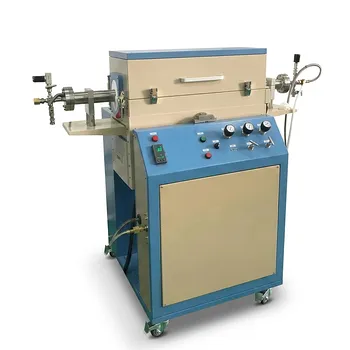
High Temperature Rocking Tube Furnace 1700°C Alumina Processing Tube with Precision Oscillation for Material Synthesis
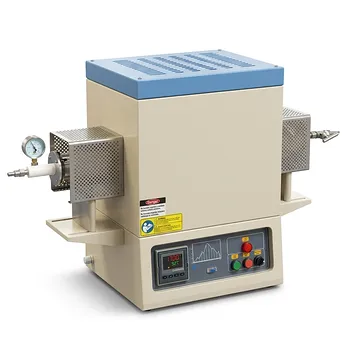
High Temperature Three Zone Tube Furnace 1700C with Alumina Tube and Water Cooled Flanges

High Temperature 1700C Vertical Tube Furnace for Powder Spherification and Material Sintering
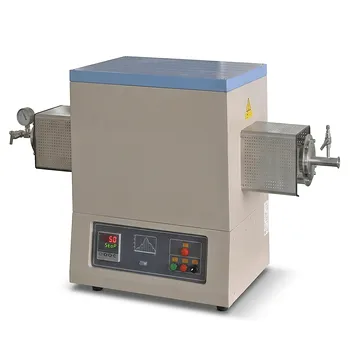
High Temperature 1700C Tube Furnace with 4 Inch OD Alumina Tube and Vacuum Sealing Flanges
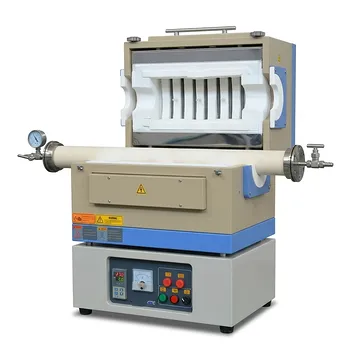
High Temperature 1600C Split Tube Furnace Vacuum Flanges Valves Optional 60mm 80mm Alumina Tube

High Temperature Automated 5 Inch Tube Furnace for Autonomous Material Research and Advanced Laboratory R&D

High Vacuum Compact Tube Furnace 1200C with Integrated Turbo Pump System and 8 Inch Heating Zone
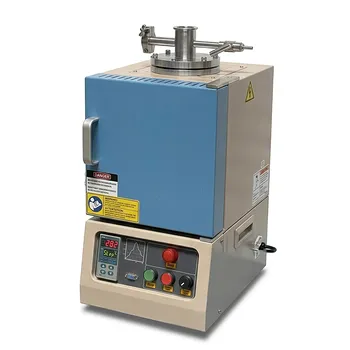
High Temperature Hybrid Muffle and Tube Furnace with Vacuum Capability and PID Control

1100°C High Temperature Quartz Chamber Furnace 8 Inch OD with 7.6 Liter Capacity and Vacuum Atmosphere Capability

1100C Tube Furnace with Vacuum Flange and Programmable Temperature Controller for Material Science and Industrial Heat Treatment
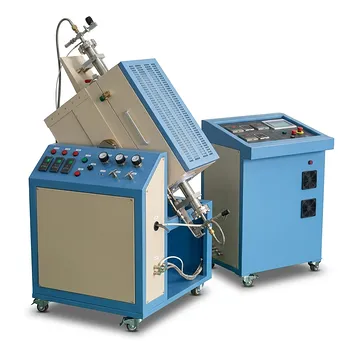
1100C High Pressure Rocking Tube Furnace with 2 Inch Super Alloy Processing Tube for Material Synthesis