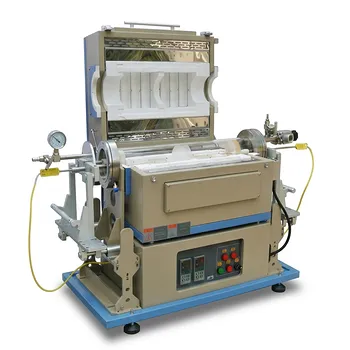
What role does a dual-zone tube furnace play in Cr0.83Te crystal growth? Precision Thermal Field Control for CVT
Updated 3 months ago
The dual-temperature zone horizontal tube furnace serves as the primary engine for the synthesis of $\text{Cr}_{0.83}\text{Te}$ single crystals. By establishing a precise thermal gradient between a $1000^\circ\text{C}$ source end and an $820^\circ\text{C}$ deposition end, the furnace creates the thermodynamic driving force required for Chemical Vapor Transport (CVT). This controlled environment ensures that gaseous intermediate products migrate effectively and deposit slowly, resulting in high-quality crystals with superior structural integrity.
Core Takeaway: The dual-zone furnace provides the essential "thermal field" regulation that dictates the movement of gaseous precursors. Its ability to maintain a stable, independent temperature differential is the deciding factor in the size, purity, and crystallinity of the $\text{Cr}_{0.83}\text{Te}$ product.
The Mechanics of Thermal Driving Force
In the CVT method, the furnace does not merely heat the materials; it creates a directional flow of matter.
Establishing the $180^\circ\text{C}$ Gradient
The furnace is programmed to maintain a specific $180^\circ\text{C}$ temperature difference across the quartz growth tube.
The source material is heated to $1000^\circ\text{C}$, while the growth or "sink" zone is kept at a cooler $820^\circ\text{C}$.
This specific gradient is critical because it determines the supersaturation level at the deposition end, which directly influences how atoms arrange themselves into a crystal lattice.
Inducing Gaseous Migration
The high temperature at the source end causes the raw materials to react with a transport agent, forming gaseous intermediate products.
Because of the temperature differential, these gases naturally migrate toward the cooler end of the tube.
Without the furnace’s ability to keep these zones distinct and stable, the gases would not move directionally, preventing the formation of a single crystal.
Ensuring Crystal Quality and Morphology
The role of the furnace extends beyond movement; it is responsible for the "slow-growth" environment necessary for high-purity results.
Maintaining a Stable Thermodynamic Environment
A dual-zone furnace provides the stability required to prevent fluctuations in the thermal field during the growth cycle.
Even minor shifts in temperature can cause the transport rate to surge or stall, leading to defects like twinning or polycrystallinity.
By keeping the thermodynamic environment constant, the furnace allows for the slow crystallization of $\text{Cr}_{0.83}\text{Te}$, which is essential for achieving centimeter-scale or high-purity specimens.
Regulating Deposition and Size
The furnace acts as a control valve for the deposition rate of the $\text{Cr}_{0.83}\text{Te}$ crystals.
The $180^\circ\text{C}$ delta provides enough energy to drive transport but remains cool enough at the sink end to prevent re-evaporation of the forming crystal.
This balance is what allows the $\text{Cr}_{0.83}\text{Te}$ single crystals to reach their desired dimensions and maintain a consistent chemical stoichiometry.
Understanding the Trade-offs
While the dual-zone furnace is indispensable, it requires careful management of specific technical variables.
Gradient Steepness vs. Crystal Defects
A steeper temperature gradient can increase the transport rate, leading to faster growth.
However, if the transport is too rapid, it often results in smaller crystal sizes or increased structural defects.
The $1000^\circ\text{C}$ to $820^\circ\text{C}$ setting is a calculated "sweet spot" that prioritizes crystal quality over sheer production speed.
Thermal Lag and Equipment Wear
Maintaining high temperatures like $1000^\circ\text{C}$ for extended periods puts significant stress on the furnace heating elements and the quartz tube.
Inaccurate calibration of the internal thermocouples can lead to a "thermal lag," where the actual temperature inside the growth tube differs from the furnace display.
Users must account for these discrepancies to ensure the stoichiometry of $\text{Cr}_{0.83}\text{Te}$ remains precise during the weeks-long growth process.
How to Apply This to Your Project
When utilizing a dual-zone furnace for CVT growth, your technical strategy should align with your specific material requirements.
- If your primary focus is Crystal Size: Maintain a lower temperature gradient (smaller $\Delta T$) to encourage slower, more deliberate growth at the deposition end.
- If your primary focus is Purity and Stoichiometry: Ensure the source zone is strictly maintained at $1000^\circ\text{C}$ to ensure complete reaction of the precursors and transport agents.
- If your primary focus is High Throughput: You may slightly increase the source temperature, but be prepared for a potential decrease in the "single-crystal" quality of the $\text{Cr}_{0.83}\text{Te}$.
Mastering the thermal field within the dual-zone furnace is the most direct path to producing high-performance $\text{Cr}_{0.83}\text{Te}$ single crystals.
Summary Table:
| Parameter | Specification | Impact on Cr0.83Te Growth |
|---|---|---|
| Source Temperature | 1000°C | Facilitates reaction of precursors into gaseous intermediates |
| Deposition Temperature | 820°C | Regulates supersaturation for high-purity single crystal formation |
| Thermal Gradient | 180°C ΔT | Provides the thermodynamic driving force for directional gas migration |
| Furnace Stability | High Precision | Prevents twinning and defects by maintaining slow, steady crystallization |
| Growth Method | CVT | Enables centimeter-scale specimens with consistent stoichiometry |
Elevate Your Material Research with THERMUNITS
Achieving high-purity Cr0.83Te single crystals requires the ultimate precision in thermal gradient control. As a leading manufacturer of high-temperature laboratory equipment, THERMUNITS provides the advanced technology needed for demanding material science and industrial R&D projects.
Our comprehensive range of thermal processing solutions—including Tube Furnaces, Vacuum/Atmosphere Furnaces, CVD/PECVD systems, and Vacuum Induction Melting (VIM) furnaces—is engineered to provide the stable thermodynamic environment essential for successful Chemical Vapor Transport (CVT).
Why partner with THERMUNITS?
- Precision Engineering: Maintain exact temperature deltas for optimal crystal stoichiometry.
- Versatile Solutions: From rotary kilns to hot press furnaces, we cover all lab heat treatment needs.
- Expert Support: Our equipment is designed to minimize thermal lag and maximize structural integrity.
Ready to optimize your lab’s efficiency and crystal quality? Contact us today to find your custom thermal solution!
References
- Shubham Purwar, S. Thirupathaiah. Intricate magnetic interactions and topological Hall effect observed in itinerant room-temperature layered ferromagnet Cr0.83Te. DOI: 10.1016/j.actamat.2024.119898
Mentioned Products
- Dual Zone Tube Furnace 1100C with 11 Inch Quartz Tube and Vacuum Flanges for 8 Inch Wafer Processing
- High Temperature 1700C Dual Zone Tube Furnace for Material Science and Industrial Chemical Vapor Deposition Research
- High Temperature 1700C Dual Zone Rotary Tube Furnace with 60mm Alumina Tube and Precision Rotation Control
- 1200C Dual Temperature Zone Slidable Tube Furnace for 2D Material Growth and TCVD Synthesis
- High Temperature Dual Zone Tube Furnace for Material Science Research and Professional Thermal Processing
People Also Ask
- What is the function of a dual-zone tube furnace in CVD for 2D perovskites? Optimize Precision & Film Uniformity
- How is a dual-temperature zone tube furnace configured for MXene-based metal phosphides? Expert Synthesis Guide
- What are the technical advantages of a dual-zone tube furnace for phosphidation? Optimize Cobalt Nanowall Synthesis.
- What are the technical advantages of using a dual-zone tube furnace system? Optimize Nanomaterial Growth & Stoichiometry
- Why is a dual-zone tube furnace necessary for ReO3-doped Cu2Te CVD? Essential for precise precursor synchronization.

Tech Team · ThermUnits
Last updated on Jun 02, 2026
Related Products
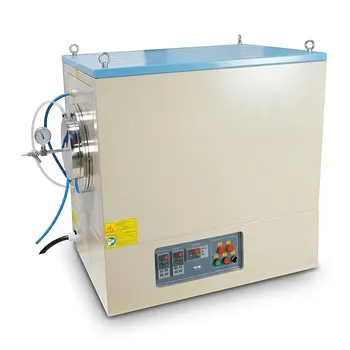
Dual Zone Tube Furnace 1100C with 11 Inch Quartz Tube and Vacuum Flanges for 8 Inch Wafer Processing
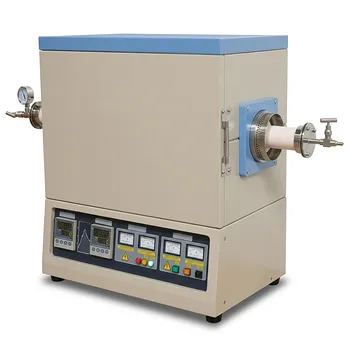
High Temperature 1700C Dual Zone Tube Furnace for Material Science and Industrial Chemical Vapor Deposition Research
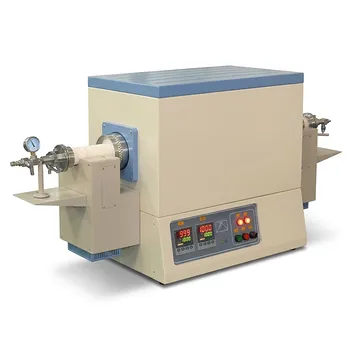
High Temperature 1700C Dual Zone Rotary Tube Furnace with 60mm Alumina Tube and Precision Rotation Control
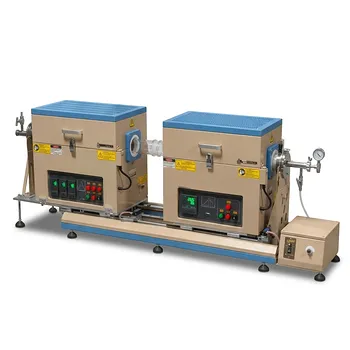
1200C Dual Temperature Zone Slidable Tube Furnace for 2D Material Growth and TCVD Synthesis
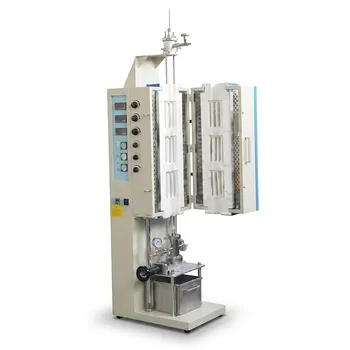
High Temperature Dual Zone Tube Furnace for Material Science Research and Professional Thermal Processing
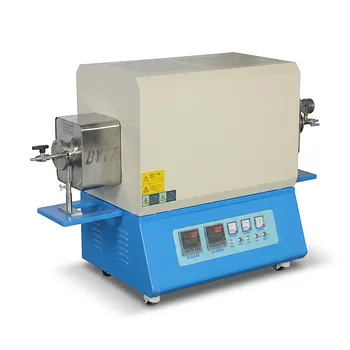
High Temperature Dual Zone Split Tube Furnace for Advanced Atmosphere Sintering and Vacuum CVD Applications
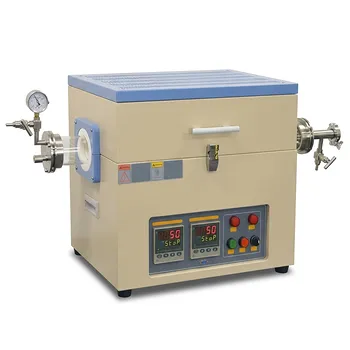
1200C Dual Zone Split Tube Furnace with Fused Quartz Tube and Vacuum Flanges Available in 60mm 80mm and 100mm Diameters
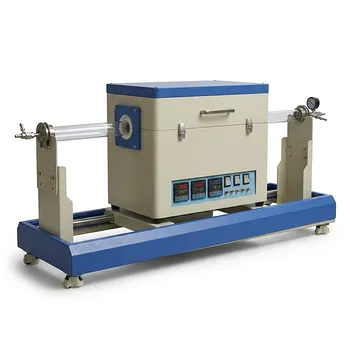
Double Temperature Zone Double Cover Tube Furnace for High Temperature CVD and Vacuum Annealing
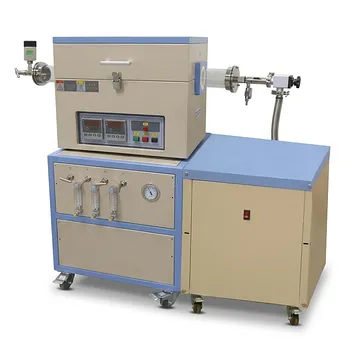
Dual Zone Quartz Tube Furnace with 80mm Diameter 1200C Max Temperature 3 Channel Gas Mixer and Vacuum Pump System
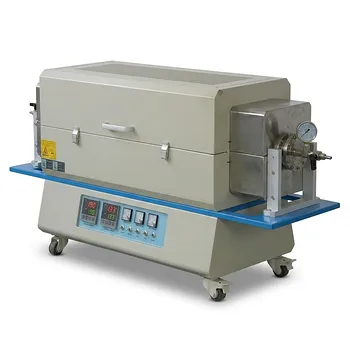
High Temperature Elongated Dual Zone Tube Furnace for Material Research and Industrial Heat Treatment
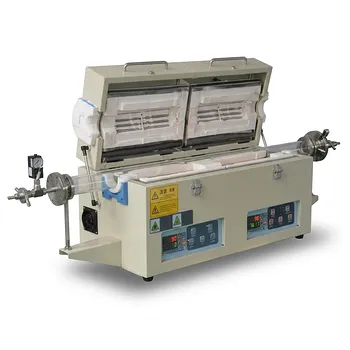
Elongated Two Temperature Zone Pipe Furnace for Industrial Heat Treatment and Material Science Research
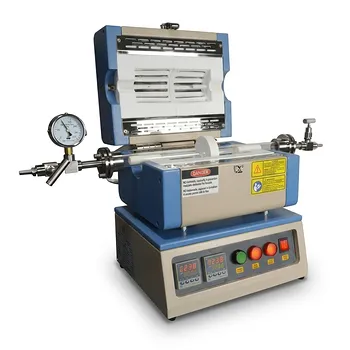
Dual Heating Zone 1200C Compact Split Tube Furnace with Optional 1" - 2" Tube and Vacuum Flanges
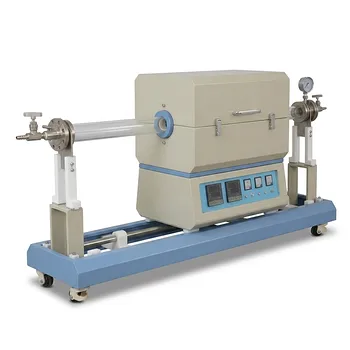
Double Zone Fast Heating Tube Furnace High Temperature Vacuum Atmosphere System
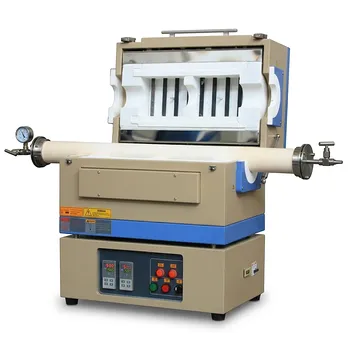
1500C Two Zone Split Tube Furnace with Vacuum Flange and 80mm Alumina Tube
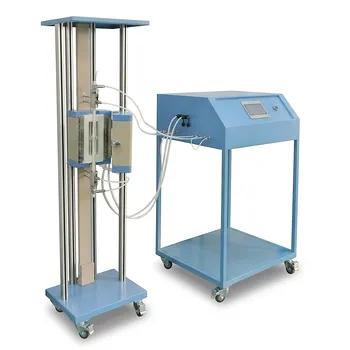
High Temperature Vertical Tube Furnace for Small Solid Oxide Fuel Cell Testing with Four Channel Gas Control
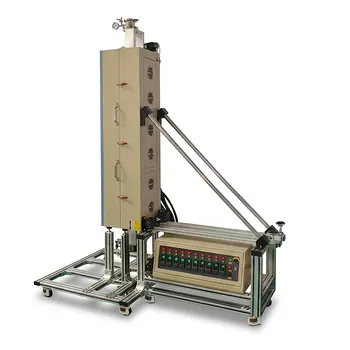
1200°C 10-Zone Split Tube Furnace with Horizontal and Vertical Mounting for Multi-Zone Thermal Gradients and Large Diameter Material Processing
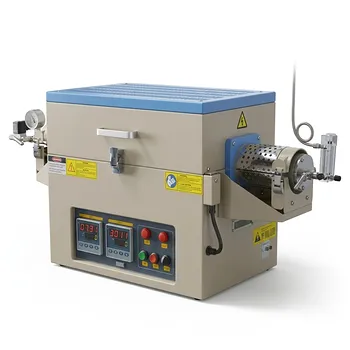
1100C Dual Zone Hydrogen Gas Tube Furnace with Quartz Tube and Integrated H2 Leak Detection System
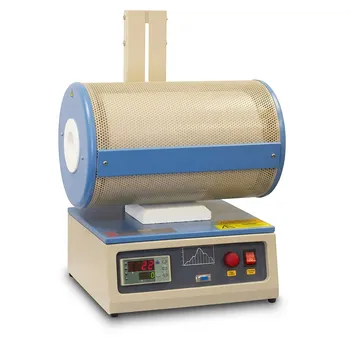
Multi Position Tube Furnace 1100C for Laboratory Material Research and Advanced Industrial Thermal Processing
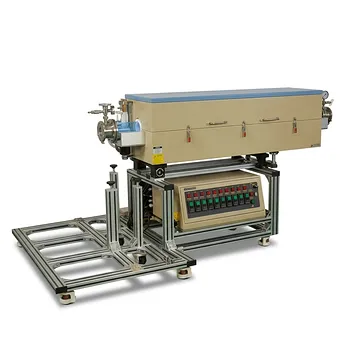
Ten Zone Multi Orientation Laboratory Tube Furnace for 1200C High Temperature Gradient Thermal Processing