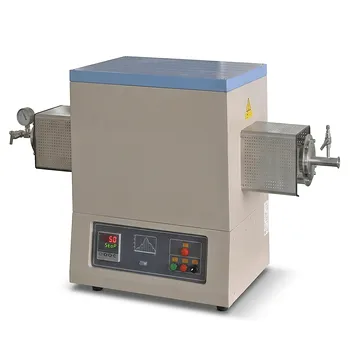
Why is a tube furnace with argon protection needed for high-carbon steel annealing? Ensure Surface Integrity.
Updated 5 months ago
The necessity of this setup lies in its ability to isolate the material from reactive gases while providing a stable thermal environment. In high-carbon steel, extreme heat triggers rapid reactions between surface carbon and atmospheric oxygen, leading to decarburization and scale formation. A tube furnace with argon protection prevents these chemical losses, ensuring that microstructural changes—like carbide dissolution—are a result of internal thermodynamics rather than environmental degradation.
Core Takeaway: To achieve successful high-temperature annealing of high-carbon steel, you must decouple thermal energy from chemical reactivity. An argon-shielded tube furnace preserves the steel’s chemical profile by displacing oxygen, allowing for precise control over internal phase transformations.
Preserving the Chemical Integrity of the Surface
Preventing Surface Decarburization
At high temperatures, carbon atoms near the surface of the steel tend to migrate outward and react with oxygen to form CO or CO2. This process, known as decarburization, softens the surface layer and compromises the intended mechanical properties of the high-carbon steel. An argon protection system creates an inert barrier that stops this carbon loss, maintaining the material’s carbon profile from the core to the surface.
Eliminating High-Temperature Oxidation
Exposure to oxygen at annealing temperatures causes the formation of iron oxide scales, which can lead to significant material loss and surface pitting. By using high-purity argon to displace oxygen and moisture, the furnace ensures the specimen remains clean and intact. This is especially critical for long-term treatments where even minor oxygen leaks could lead to severe surface degradation over time.
Controlling Microstructural Evolution
Enabling Purely Thermodynamic Changes
The primary goal of annealing high-carbon steel is often to dissolve or coarsen carbides to reach a specific equilibrium state. A tube furnace provides a highly uniform thermal field, which ensures that these microscopic changes occur consistently throughout the sample. Because the argon atmosphere prevents surface reactions, researchers can be confident that the resulting microstructure is driven solely by heat and time, not by external chemical interference.
Facilitating Long-Term Diffusion
Eliminating micro-chemical segregation requires long-term diffusion at extreme temperatures, sometimes reaching 1200°C or higher. During these extended periods, the stability of the argon flow is vital for maintaining internal chemical homogenization. Without this protection, the steel would undergo "oxidative combustion" of its carbon components, fundamentally changing the alloy's identity before the diffusion process is even complete.
Understanding the Trade-offs and Limitations
The Risk of Impure Gas Streams
While argon is inert, the effectiveness of the system is entirely dependent on the purity of the gas and the integrity of the furnace seals. Even trace amounts of moisture or oxygen in the argon line can cause subtle oxidation or "tinting" of the steel surface. For critical applications, gas purification systems or "getters" may be required to ensure the atmosphere is truly non-reactive.
Challenges of Flow Rate Management
Constant argon flow is necessary to displace outgassing from the sample, but high flow rates can lead to non-uniform cooling or thermal gradients across the tube. Finding the balance between enough flow to maintain a positive pressure and low enough flow to maintain thermal stability is a common operational challenge. Additionally, an argon atmosphere does not "fix" existing oxidation; it only prevents further damage from occurring.
How to Apply This to Your Project
Selecting the Right Parameters
- If your primary focus is surface hardness and wear resistance: Prioritize a high-purity argon (99.999%) and a strictly sealed tube environment to prevent any carbon loss during the soak.
- If your primary focus is internal chemical homogeneity: Use a moderate argon flow rate combined with a slow, controlled heating rate (e.g., 5°C/min) to ensure the core and surface reach equilibrium simultaneously.
- If your primary focus is preserving trace elements in specialized alloys: Ensure the furnace is purged multiple times before heating to completely eliminate residual oxygen that could react with sensitive alloying agents.
By effectively masking the environment with argon, you ensure that the high-temperature energy provided by the tube furnace is used exclusively for structural refinement rather than destructive chemical reactions.
Summary Table:
| Feature | Argon-Protected Tube Furnace | Standard Furnace (Air) |
|---|---|---|
| Surface Carbon | Preserved (No Decarburization) | Lost (Surface Softening) |
| Oxidation | Eliminated (No Scale) | Heavy Scale & Material Loss |
| Microstructure | Driven by Internal Thermodynamics | Altered by Environmental Reaction |
| Heat Uniformity | Highly Uniform in Sealed Tube | Variable with Atmospheric Air |
| Application Focus | Critical R&D and High-End Alloys | Basic Heat Treatment |
Elevate Your Research with THERMUNITS Thermal Solutions
As a leading manufacturer of high-temperature laboratory equipment for material science and industrial R&D, THERMUNITS understands that precision is non-negotiable. Our specialized argon-shielded tube furnaces provide the inert environment necessary to eliminate decarburization and protect the integrity of your high-carbon steel alloys.
Whether you require Muffle, Vacuum, Atmosphere, Tube, Rotary, or Hot Press furnaces, or advanced CVD/PECVD systems and vacuum induction melting furnaces (VIM), our equipment is designed to deliver superior thermal stability. Partner with THERMUNITS to access a comprehensive range of thermal processing solutions tailored to your specific research needs.
Ready to optimize your heat treatment process? Contact our expert team today to discuss your laboratory requirements and discover the THERMUNITS advantage.
References
- J. Krawczyk, Sebastian Lech. Analysis of the Wear Parameters and Microstructure of High-Carbon Steel in Order to Identify Its Tribological Properties. DOI: 10.3390/app14188318
Mentioned Products
- 1200C High Throughput Multi Channel Tube Furnace with 50mm Quartz Tubes for Annealing and Material Phase Diagram Research
- High Throughput 1200C Four Channel Tube Furnace with 3 Inch Quartz Tubes for Multi Zone Annealing and Material Research
- High Temperature 1700C 4 Channel Tube Furnace 1 Inch Alumina Tube for Hi-Throughput Annealing
- 1200C High Temperature 5 Inch Sliding Tube Furnace for Rapid Thermal Processing RTP and Wafer Annealing
- High Temperature 1800C Atmosphere Tube Furnace for CVD Research and Vacuum Sintering Precision Heat Treatment
People Also Ask
- Why is high-purity alumina selected for sample trays? Key to High-Throughput Sintering Success
- How does a high-throughput tube furnace achieve precise sulfurization? Expert Control for CoS2–Co(OH)F Nanostructures
- How does the precise temperature control of a tube furnace influence the formation of V2AlC MAX phase? Expert Insights.
- What is the function of argon gas flow within a tube furnace during the selenization of MOFs? Essential Process Guide
- What is the effect of introducing camphor as a carbon source in a tube furnace CVD? Boost CNT Density and Growth

Tech Team · ThermUnits
Last updated on Apr 14, 2026
Related Products
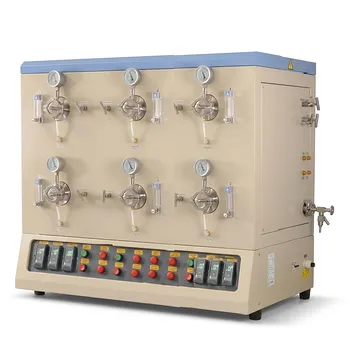
1200C High Throughput Multi Channel Tube Furnace with 50mm Quartz Tubes for Annealing and Material Phase Diagram Research
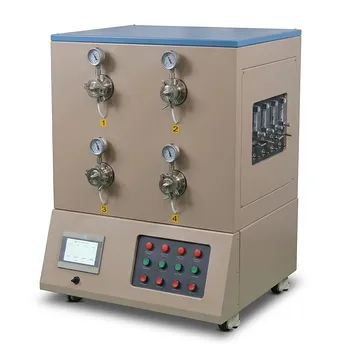
High Throughput 1200C Four Channel Tube Furnace with 3 Inch Quartz Tubes for Multi Zone Annealing and Material Research
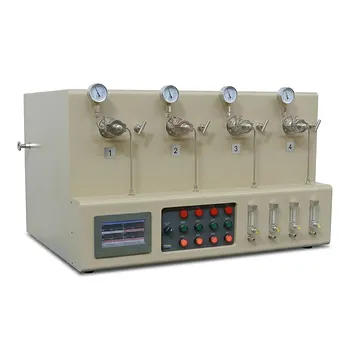
High Temperature 1700C 4 Channel Tube Furnace 1 Inch Alumina Tube for Hi-Throughput Annealing
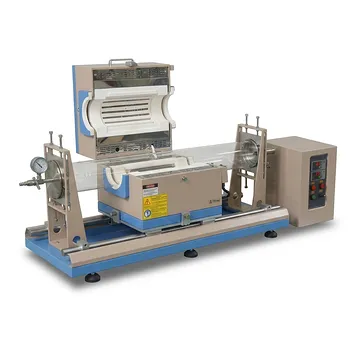
1200C High Temperature 5 Inch Sliding Tube Furnace for Rapid Thermal Processing RTP and Wafer Annealing
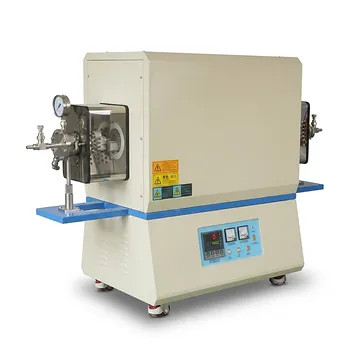
High Temperature 1800C Atmosphere Tube Furnace for CVD Research and Vacuum Sintering Precision Heat Treatment
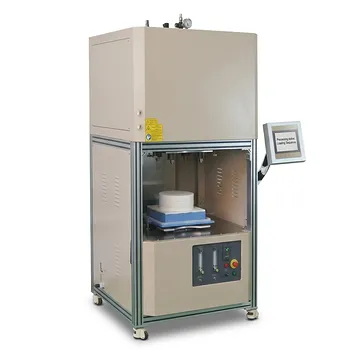
High Temperature Vertical Atmosphere Controlled Furnace with Automatic Bottom Loading and 1700°C Capacity for Advanced Material Research
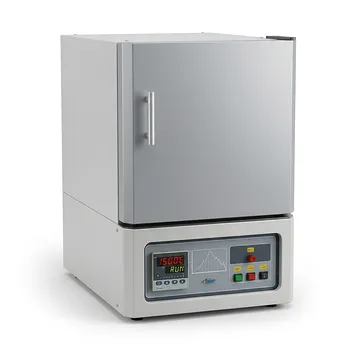
High Temperature 1500C Benchtop Muffle Furnace 3.6L Alumina Fiber Chamber Programmable Controller Sintering Annealing Carbonization Thermal Processing System
900 ºC Max Sliding RTP Tube Furnace with Rapid IR Heating and 4 Inch OD Quartz Tube
1200°C 5 Inch Vertical Quartz Tube Furnace with Stainless Steel Vacuum Flanges
1200C Five Side Heating Muffle Furnace with Sliding Door 125L Volume High Temperature Heat Treatment System for Large Scale Sintering and Annealing
Large Bench Top 1700C High Temperature Muffle Furnace with 19L Chamber for Advanced Material Sintering and Annealing

High Temperature 1700C Vertical Tube Furnace for Powder Spherification and Material Sintering

Compact High Temperature 1600C Tube Furnace with 50mm Alumina Tube and Vacuum Flanges for Material Sintering
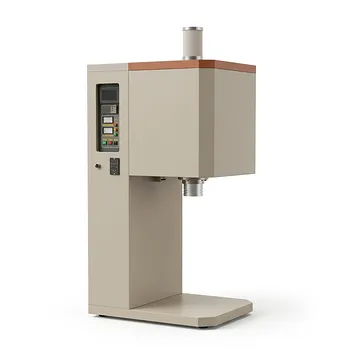
Vertical Openable Tube Furnace 0-1700c High Temperature Laboratory System for CVD and Vacuum Heat Treatment

Vertical 1700C Vacuum and Atmosphere Tube Furnace with 80mm Alumina Tube
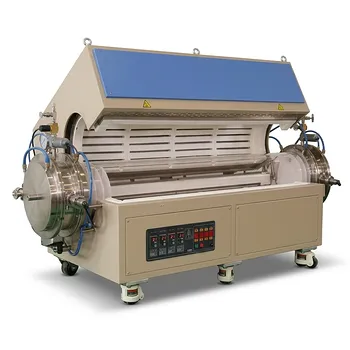
1200C Max Four Zone Split Tube Furnace with Optional Large Diameter Quartz Tubes
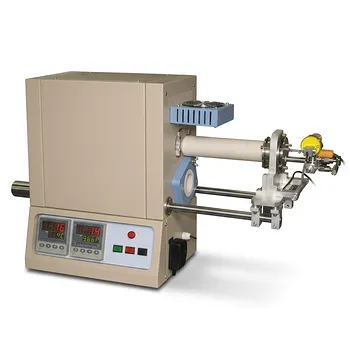
High Temperature Tube Furnace 1500C with Sliding Flanges and 50mm OD for Rapid Thermal Processing Fast Heating and Cooling
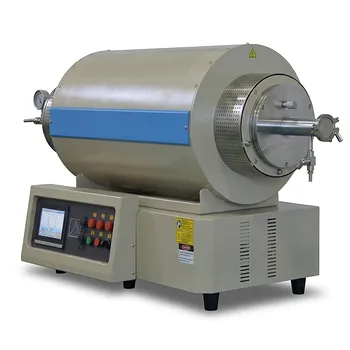
1200C Max Three Zone Tube Furnace 6 Inch OD Max with Tube and Flange
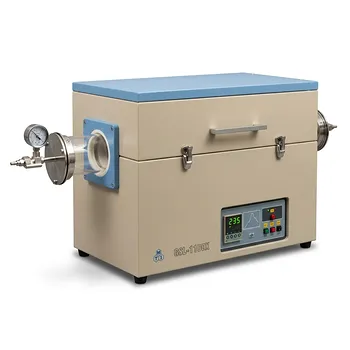
Single Zone Tube Furnace 5 Inch Quartz Tube 36 Inch Heating Zone Vacuum Flanges