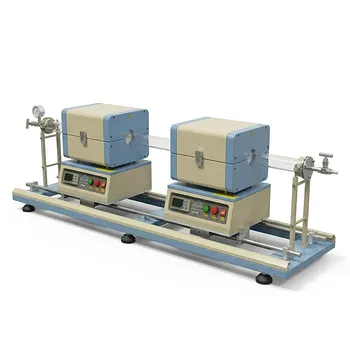
What specific role does a high-temperature tube furnace play in CaSi2 research? Unlocking Precision Polytype Control
Updated 3 months ago
The high-temperature tube furnace acts as a precision thermal reactor for $CaSi_2$ research. Its primary role is to provide a highly uniform and stable heat environment that allows researchers to trigger and observe the transformation from the 6R-type polytype to the 3R-type polytype.
A high-temperature tube furnace is essential for isolating the variables of temperature and time to determine the phase stability and transformation kinetics of $CaSi_{2}$ stacking variants. It provides the controlled environment necessary to prevent oxidation while facilitating structural changes at a molecular level.
Precision Control of Phase Transformation Kinetics
Facilitating the 6R to 3R Transition
The furnace allows for the controlled heating of encapsulated $CaSi_{2}$ samples, typically at specific temperatures such as 600°C. Maintaining this exact thermal state is critical for observing how the crystal structure shifts from the 6R to the 3R stacking arrangement.
Mapping Temperature and Duration
By varying the heat treatment duration, researchers can use the furnace to map the kinetics of the transformation. This data reveals how time and thermal energy interact to influence the formation of different layer stacking variants.
Maintaining Environmentally Sensitive Samples
Atmosphere Control and Inert Protection
While $CaSi_{2}$ research often uses encapsulated samples, tube furnaces offer the ability to introduce inert gases like Argon. This prevents the oxidation of raw materials, ensuring that the structural changes observed are due to thermal effects rather than chemical contamination from the surrounding air.
Thermal Uniformity and Consistency
The furnace creates a constant temperature zone, which is vital for maintaining high-quality results across the entire sample. Uniformity ensures that the nucleation and growth kinetics of the polytype transformation are consistent, preventing localized structural variations that could skew research data.
Understanding the Trade-offs
Thermal Gradients and Sample Placement
If a sample is placed outside the furnace's designated "hot zone," it may experience thermal gradients. These temperature inconsistencies can lead to incomplete phase transformations or the simultaneous presence of multiple polytypes, complicating the analysis of the 6R to 3R transition.
Heating Rates and Material Stress
Rapid heating or cooling can induce mechanical stress or macro-cracks in sensitive materials. While some processes require fast transitions, $CaSi_{2}$ polytype research often benefits from controlled, slower heating rates to avoid damaging the crystal lattice during its structural reorganization.
How to Apply Laboratory Furnaces to Materials Research
Designing a successful thermal experiment requires aligning furnace capabilities with the specific needs of the material's phase diagram.
- If your primary focus is Phase Identification: Use the furnace to hold samples at precise isothermal points to ensure they reach a state of equilibrium before quenching and analysis.
- If your primary focus is Oxidation Prevention: Ensure the tube furnace is equipped with a reliable gas flow control system to maintain a high-purity Argon atmosphere throughout the heating cycle.
- If your primary focus is Kinetic Modeling: Conduct multiple runs at varying durations and temperatures to generate the data points necessary to calculate transformation activation energy.
The high-temperature tube furnace remains the definitive tool for researchers seeking to master the structural transformations of $CaSi_{2}$ through precise thermal manipulation.
Summary Table:
| Role in CaSi2 Research | Key Benefit | Technical Requirement |
|---|---|---|
| Phase Transformation | Facilitates 6R to 3R transition | Stable isothermal states (e.g. 600°C) |
| Kinetic Modeling | Maps transformation time & energy | Variable duration & thermal zones |
| Inert Environment | Prevents sample oxidation | High-purity Argon gas flow |
| Thermal Uniformity | Ensures consistent nucleation | Designated "hot zone" stability |
Elevate Your Materials Research with THERMUNITS
Are you conducting advanced research on $CaSi_2$ polytypes or other high-temperature structural transformations? THERMUNITS is a leading manufacturer of high-performance laboratory equipment designed for the rigors of material science and industrial R&D.
Our comprehensive range of thermal processing solutions—including Tube Furnaces, Muffle, Vacuum, Atmosphere, Rotary, and Hot Press furnaces, CVD/PECVD systems, and VIM furnaces—ensures unmatched thermal uniformity and precise atmosphere control for your most sensitive samples.
Ready to optimize your heat treatment process?
Contact THERMUNITS today to find the perfect furnace for your laboratory!
References
- Xian‐Juan Feng, Michael Baitinger. Deciphering the Polymorphism of CaSi<sub>2</sub>: The Influence of Heat and Composition. DOI: 10.1021/acs.inorgchem.4c00902
Mentioned Products
- High Temperature Dual Zone Rotating Tube Furnace 1500C Silicon Carbide Heating for Advanced Material Synthesis
- High Temperature 1700C Vertical Tube Furnace for Powder Spherification and Material Sintering
- High Temperature Tube Furnace 1500C with Sliding Flanges and 50mm OD for Rapid Thermal Processing Fast Heating and Cooling
- Compact High Temperature 1600C Tube Furnace with 50mm Alumina Tube and Vacuum Flanges for Material Sintering
- 1800C High Temperature Compact Vacuum Tube Furnace with 60mm OD Alumina Tube and Kanthal MoSi2 Heating Elements
People Also Ask
- What is the function of CVD furnaces in graphene prep? Enhancing Photodetector Charge Transport
- Why use CVD and a tube furnace for Pd3P0.95/NC catalyst phosphidation? Ensure high phase purity and performance.
- CVD Tube Furnace Advantages for Pd-P Catalyst Durability: Precision Control for 40,000+ Cycles
- How does a rotary tube furnace improve the processing of granular materials? Enhance Uniformity and Reaction Kinetics
- How does a Chemical Vapor Deposition (CVD) tube furnace facilitate synchronized nitridation? Precision Nano-Engineering.

Tech Team · ThermUnits
Last updated on Jun 03, 2026
Related Products
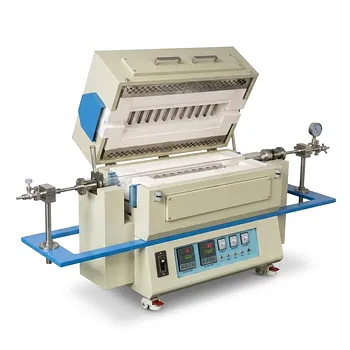
High Temperature Dual Zone Rotating Tube Furnace 1500C Silicon Carbide Heating for Advanced Material Synthesis

High Temperature 1700C Vertical Tube Furnace for Powder Spherification and Material Sintering

High Temperature Tube Furnace 1500C with Sliding Flanges and 50mm OD for Rapid Thermal Processing Fast Heating and Cooling

Compact High Temperature 1600C Tube Furnace with 50mm Alumina Tube and Vacuum Flanges for Material Sintering

1800C High Temperature Compact Vacuum Tube Furnace with 60mm OD Alumina Tube and Kanthal MoSi2 Heating Elements

1750°C High Temperature Benchtop Vacuum Atmosphere Tube Furnace with Kanthal Super 1800 Heating Elements and 60mm Alumina Processing Tube

High Temperature 1700C Tube Furnace with High Vacuum Turbomolecular Pump System and Multi Channel Mass Flow Controller Gas Mixer
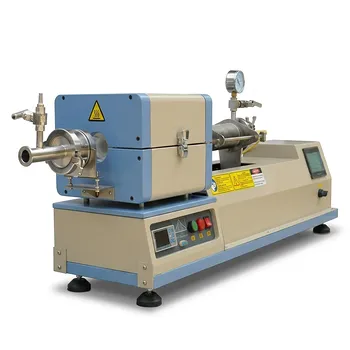
High Temperature 1200C Split Tube Furnace with Internal Travel Mechanism for HPCVD and Crystal Growth Research
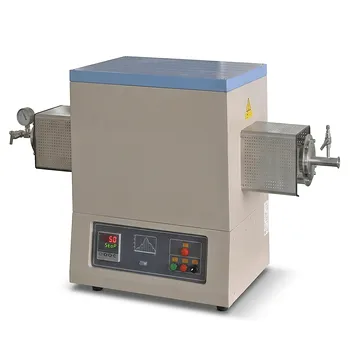
High Temperature 1700C Tube Furnace with 4 Inch OD Alumina Tube and Vacuum Sealing Flanges
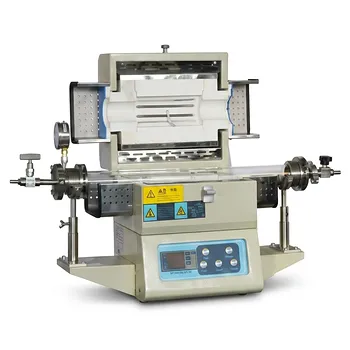
High Temperature 1200C Split Tube Furnace for CVD Research and Vacuum Atmosphere Heat Treatment
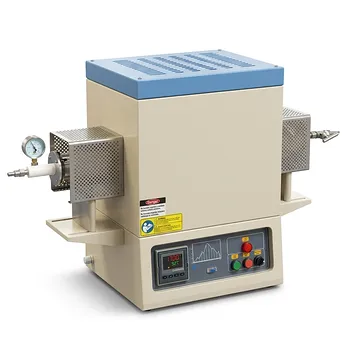
High Temperature Three Zone Tube Furnace 1700C with Alumina Tube and Water Cooled Flanges
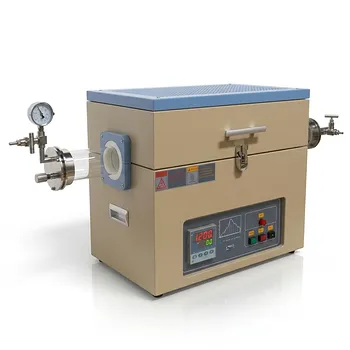
High Temperature 1200C Split Tube Furnace with Optional Quartz Tube Sizes and Vacuum Sealing Flanges for Material Science Research

High Temperature 1700C Benchtop Tube Furnace with 5 Inch Heating Zone High Purity Alumina Tube and Vacuum Sealing Flanges
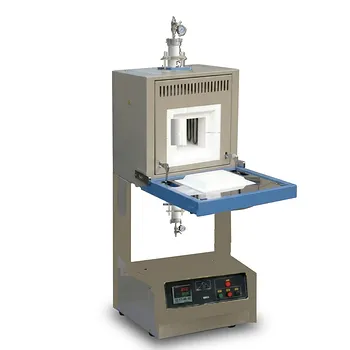
High Temperature Vertical Hybrid Furnace with Alumina Tube and SiC Heating for SOFC Coin Cell Testing and Atmosphere Processing

High Temperature Automated 5 Inch Tube Furnace for Autonomous Material Research and Advanced Laboratory R&D
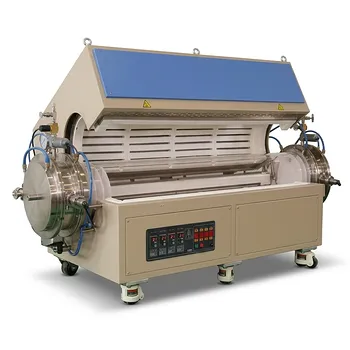
1200C Max Four Zone Split Tube Furnace with Optional Large Diameter Quartz Tubes

1100°C High Temperature Quartz Chamber Furnace 8 Inch OD with 7.6 Liter Capacity and Vacuum Atmosphere Capability
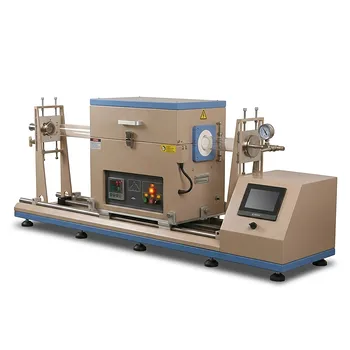
1200C Sliding Tube Furnace for Rapid Thermal Processing and CVD Graphene Growth with 100mm OD Capacity
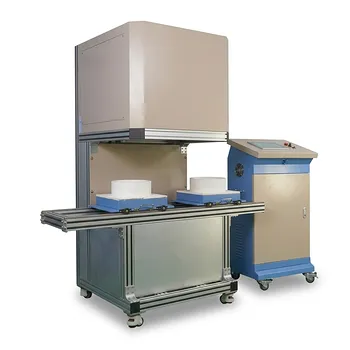
High Temperature Bottom Loading Vertical Furnace 1700C Dual Stage Sample Processing System 18L Large Capacity Thermal Treatment Equipment